
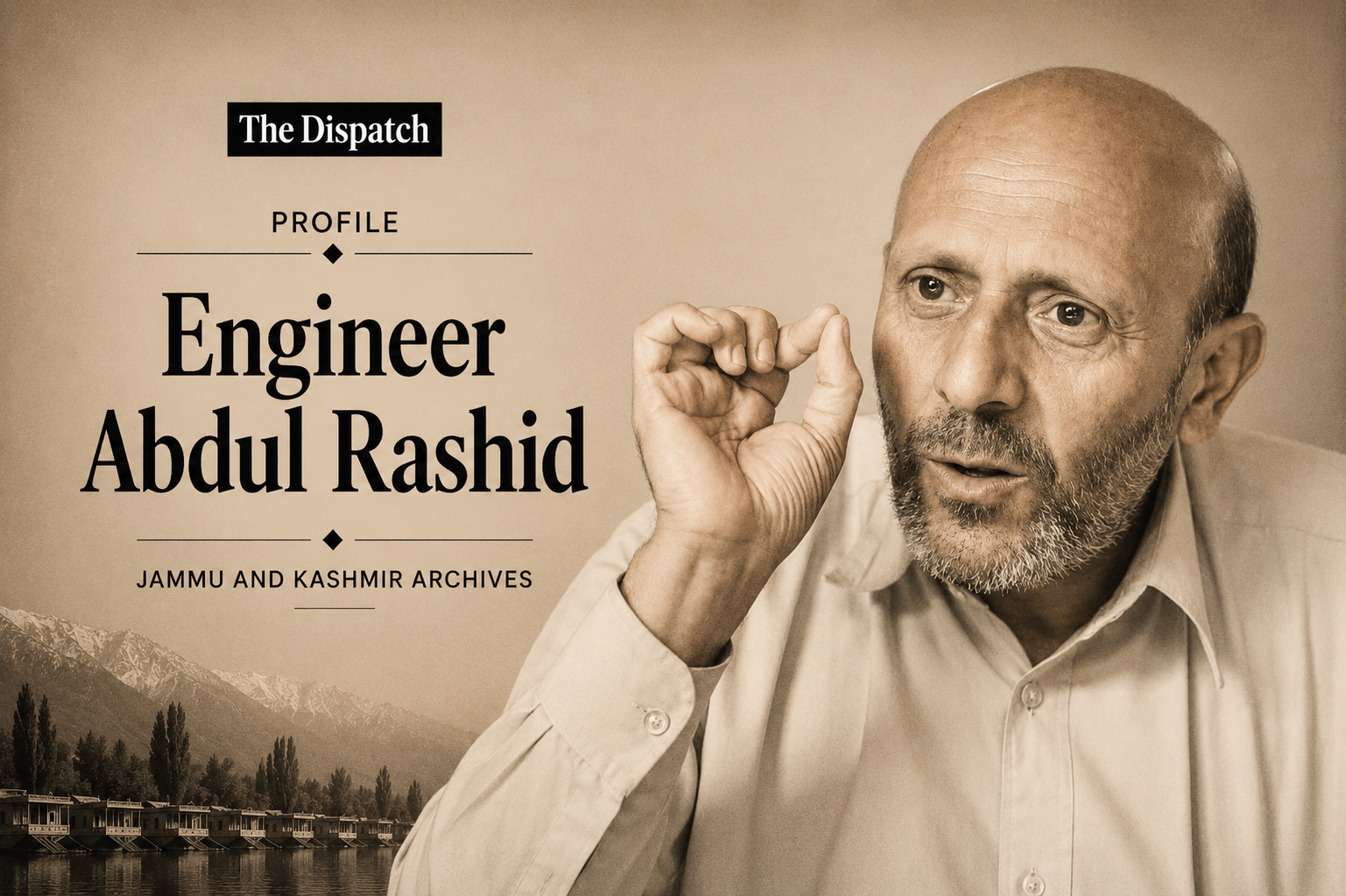
Defiance, Detention, and the Politics of Disruption
In a political landscape long shaped by established families and structured organisations, Engineer Rashid has stood apart—neither inheriting legacy nor aligning comfortably with dominant narratives. His politics has been defined by defiance, symbolism, and a persistent anti-establishment posture, often unsettling the conventions of both mainstream and separatist spaces.
Born in 1967 in Langate in north Kashmir, Rashid trained as a civil engineer before entering public life. His rise was not facilitated by party structures but built through local engagement and constituency-level credibility. His election as an independent MLA in 2008, and again in 2014, marked him out as an unusual figure—someone able to convert personal mobilisation into electoral success without organisational backing.
His political style has remained distinctive. Rashid has relied on direct action, provocative articulation, and public positioning on contentious issues, often placing himself at the centre of debate. Unlike leaders who operate through calibrated messaging, his approach has been immediate and confrontational, aimed as much at visibility as at representation.
At the same time, he has remained within the electoral framework. This duality—participation within the system while openly challenging it—has defined his politics. He has articulated positions on Kashmir’s political question, governance deficits, and human rights concerns in a manner that resonates with sections of the population that feel excluded from both mainstream parties and structured separatist leadership.
His trajectory, however, took a decisive turn in 2019, when he was arrested and has since remained in incarceration. This development might have been expected to diminish his political presence. Instead, it produced a different outcome.
In the 2024 Lok Sabha elections, Rashid, contesting from custody, defeated Omar Abdullah—one of the most prominent leaders in Jammu and Kashmir. The result was politically significant, not merely as an electoral upset, but as an indication of the continuing resonance of his anti-establishment appeal. It suggested that his political message retained traction even in absence, and that sections of the electorate were willing to endorse a figure positioned outside conventional power structures.
Yet, this success also underlines the limits of his politics. Rashid’s influence remains highly personalised and geographically concentrated, without a broader organisational framework to sustain expansion. His style generates momentum, but not necessarily structure.
Engineer Rashid’s significance lies less in the offices he has held and more in the challenge he poses to established political forms. He represents a strand of politics that is immediate, confrontational, and rooted in visible dissent—operating within the system while questioning its legitimacy.
He remains in custody, yet politically relevant.
His career raises a question that continues to echo in Jammu and Kashmir: whether disruption from within the system can evolve into a durable political alternative—or remain a powerful, but limited, expression of dissent.
Leave a Reply