
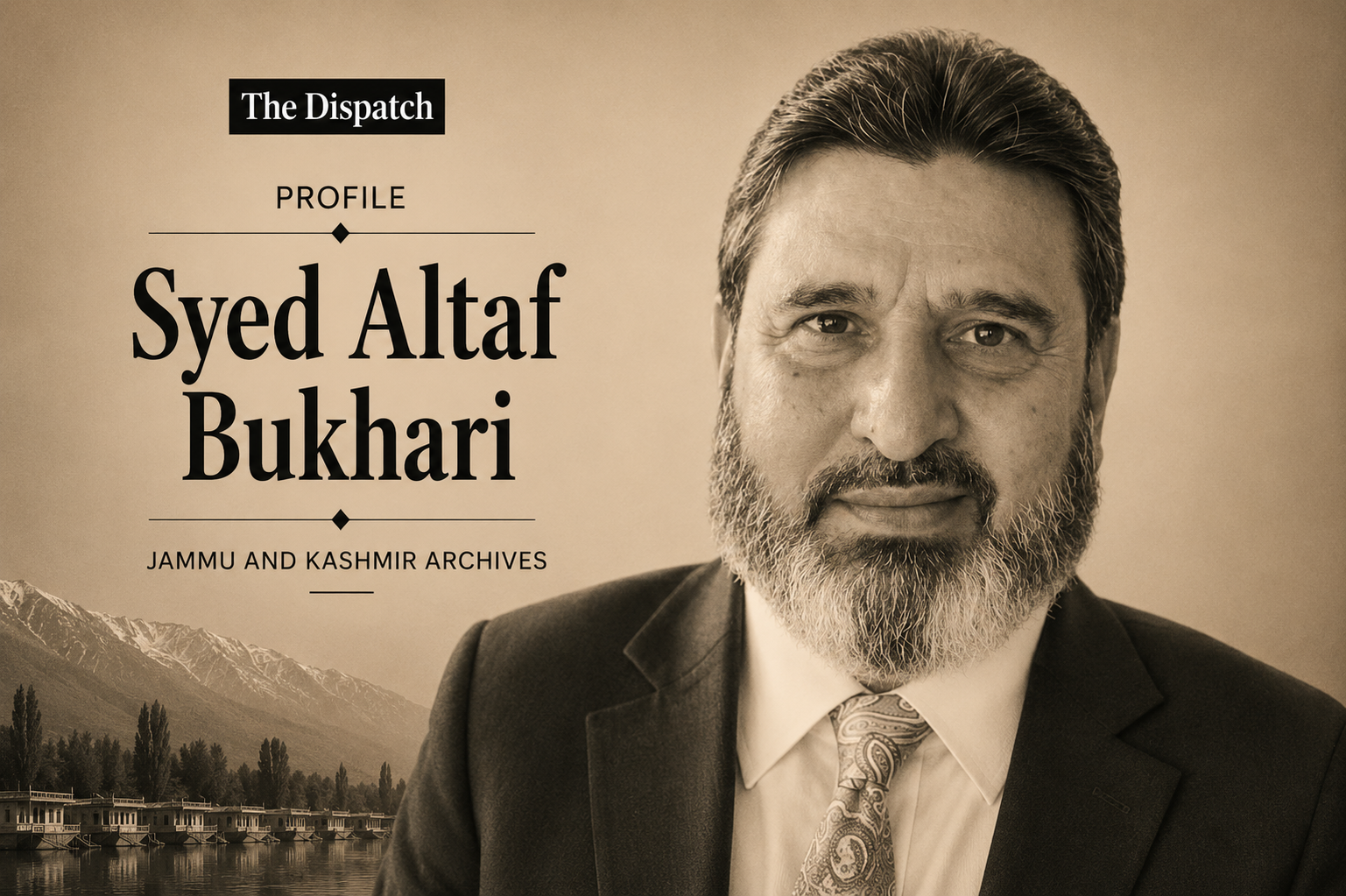
A Political Experiment in the New Jammu and Kashmir
Few political figures in contemporary Jammu and Kashmir embody the turbulence and transition of the post-2019 era as distinctly as Syed Altaf Bukhari.
Businessman, political organiser and founder of the Jammu and Kashmir Apni Party, Bukhari occupies a unique space in the region’s political landscape. Admired by supporters as pragmatic and sharply strategic, and criticised by opponents as a beneficiary of New Delhi’s post-August 2019 political order, he nevertheless emerged as one of the most consequential political actors in the Union Territory after the abrogation of Article 370.
Born in Srinagar in 1964, Altaf Bukhari’s rise differed significantly from the traditional political pathways of Jammu and Kashmir. Unlike leaders shaped primarily through ideological movements or grassroots activism, Bukhari entered public life with the reputation of being among the Valley’s most influential businessmen. He is widely regarded as one of the wealthiest political figures the region has produced.
Yet, his association with politics traces back much earlier than his formal electoral career.
Political circles in Jammu and Kashmir have long associated Bukhari with the dramatic events of 1984, when Farooq Abdullah’s government fell following defections within the National Conference. It is widely believed that Bukhari, then still a young man, played a role in facilitating hospitality and safe arrangements for legislators involved in the rebellion that altered the political course of the state.
His formal political ascent, however, came decades later.
Bukhari eventually joined mainstream politics and became a prominent minister in the PDP-BJP coalition government led by Mufti Mohammad Sayeed and later Mehbooba Mufti after 2015. Known for administrative efficiency and direct accessibility, he cultivated an image of a grounded and practical politician rather than a purely ideological one.
But it was after August 2019 that Altaf Bukhari became central to the political conversation in Jammu and Kashmir.
Following the withdrawal of the region’s special constitutional status and its reorganisation into a Union Territory, almost the entire established political leadership — including former chief ministers — was detained. Public political activity had virtually collapsed.
It was in this uncertain atmosphere that Bukhari made a decisive move.
In early 2020, he met Lieutenant Governor G. C. Murmu, signalling publicly that he had accepted the political reality created by August 2019 and believed the region must move forward within the new framework. Soon afterwards, in March 2020, he launched the Jammu and Kashmir Apni Party.
The launch itself was historic in scale.
With nearly two dozen former ministers, legislators and influential political figures joining at inception, it became perhaps the largest-ever launch of a political party in Jammu and Kashmir’s history. Days later, Bukhari led delegations to meetings with Prime Minister Narendra Modi and Home Minister Amit Shah, reinforcing the perception that his party intended to engage with New Delhi rather than confront the constitutional changes of 2019.
Critics quickly accused the Apni Party of being encouraged by the political establishment in Delhi. Supporters, however, argued that Bukhari represented a new political realism in a transformed constitutional landscape.
The ultimate electoral test came in 2024.
Despite its visibility, organisational strength and high-profile leadership, the Apni Party failed to win even a single seat in the Assembly elections. The verdict underscored the continuing emotional and political complexities surrounding post-2019 politics in Jammu and Kashmir.
Even so, Altaf Bukhari’s place in the region’s contemporary political history remains secure.
Whether viewed as a pragmatist adapting to irreversible change or as a controversial architect of a new political order, he became one of the defining faces of Jammu and Kashmir’s transition after Article 370.
Leave a Reply