
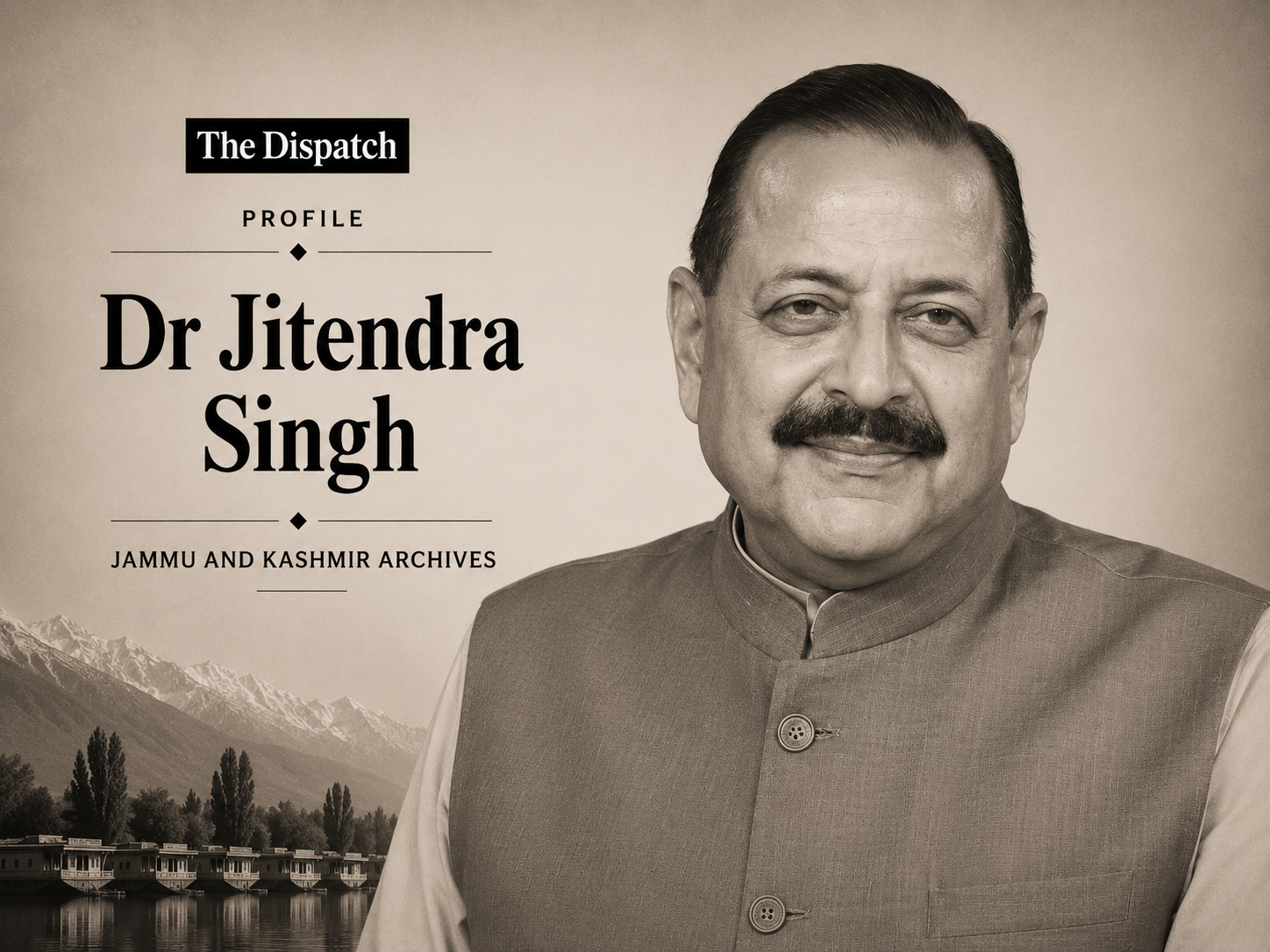
From Commentary to Power: A Delhi-Centred Presence in J&K Politics
In the contemporary political landscape of Jammu and Kashmir, Jitendra Singh represents a strand distinct from legacy politics and separatist traditions. His rise has been late, sudden, and shaped as much by circumstance as by design, eventually placing him at the heart of the Union government’s administrative framework.
Born in 1956 in Jammu, Jitendra Singh came from a family embedded in the state’s professional and cultural life. His father, Rana Rajendra Singh, served as a Chief Engineer and maintained proximity with the family of Sheikh Mohammad Abdullah, reflecting the interconnected elite networks of an earlier era. A patron of Urdu poetry, he represented a milieu where administration, culture, and social ties often overlapped.
His younger brother, Devender Singh Rana, took a different path—building a substantial business presence through automobile dealerships and later emerging as a politically influential figure in Jammu, closely aligned with Omar Abdullah during the National Conference government between 2009 and 2014. The contrast between the two brothers reflects the multiple routes to power in the region.
Jitendra Singh himself did not begin as a politician. A medical specialist in endocrinology, he built a professional career while also establishing himself as a widely read columnist. His column, Tales of Travesty, appeared in Kashmir Times and carried a distinctive style—blending current affairs with literary flourish, often concluding with Urdu couplets, including those of Mirza Ghalib. At this stage, he was seen as a thoughtful public commentator rather than a political aspirant.
The shift began in the early 1990s, shaped by the changing media and political climate of Jammu and Kashmir. As militancy intensified, Kashmir Times came under criticism in sections of Jammu for what was perceived as a softer line on separatism, while Daily Excelsior adopted a strongly nationalist editorial stance and rapidly expanded its influence. In a move that surprised many readers, Jitendra Singh shifted his column to Daily Excelsior, aligning himself with a platform that was gaining ground in Jammu’s public discourse.
His entry into active politics, however, came much later—and almost incidentally. The Amarnath land agitation of 2008 transformed regional tensions into a national debate, with television studios becoming as crucial as developments on the ground. Kashmiri leaders such as Mehbooba Mufti, Omar Abdullah, and Sajjad Lone articulated their positions effectively on national platforms, while Jammu’s political leadership struggled to match that articulation.
It was in this context that Arun Jaitley looked for voices beyond the party’s conventional ranks. Jitendra Singh emerged as an articulate and composed presence on television debates—measured, confident, and persuasive. This visibility brought him into the BJP’s inner circles in Jammu and set the stage for his formal political entry.
In 2014, he was fielded against Ghulam Nabi Azad in the Lok Sabha elections. The contest was emblematic—a political novice against a seasoned national figure. In the broader context of the Congress’s decline and the rise of Narendra Modi, Jitendra Singh secured a decisive victory, marking his arrival in national politics.
He was soon inducted as Minister of State in the Prime Minister’s Office, a position he has retained across successive terms, making him one of the longest-serving faces in the PMO. His responsibilities have spanned key administrative domains, and his role has been defined by continuity, discipline, and proximity to the central leadership.
Yet, as with figures like Azad before him, his presence in Delhi has not translated into a clearly identifiable role in shaping core policy decisions on Jammu and Kashmir, which remain concentrated within the domain of Amit Shah and the Union Home Ministry. His influence is therefore institutional rather than strategic in the Kashmir context.
Regionally, his base lies in Jammu, and his appeal remains largely confined to that geography. He does not operate as a mass leader across regions, nor as a mediator between Jammu and Kashmir. Instead, he represents a category of leadership defined by alignment with the Centre and administrative continuity.
Jitendra Singh’s trajectory—from columnist to national office—remains unusual in the politics of the region. It reflects the role of communication, timing, and circumstance in shaping political careers, particularly in moments of crisis.
Alongside his political and administrative roles, he has maintained a consistent engagement with writing. He has authored and edited several books, including works on public policy, governance, and political biography. Titles such as “What Ails Indian Parliament” examine institutional functioning and legislative challenges, while “Resurgent India: Governance, Growth and Development” reflects his perspective on policy and reform in contemporary India. He has also written on historical and political themes, bringing together his background as a commentator and practitioner. Across these works, there is a continuity of tone—analytical, structured, and anchored in institutional thinking.
In a political landscape that has shifted from negotiated federalism to a more centralised framework, Jitendra Singh stands as a figure who embodies that transition—where Delhi is not merely a participant in Jammu and Kashmir’s politics, but its principal axis.
Leave a Reply