
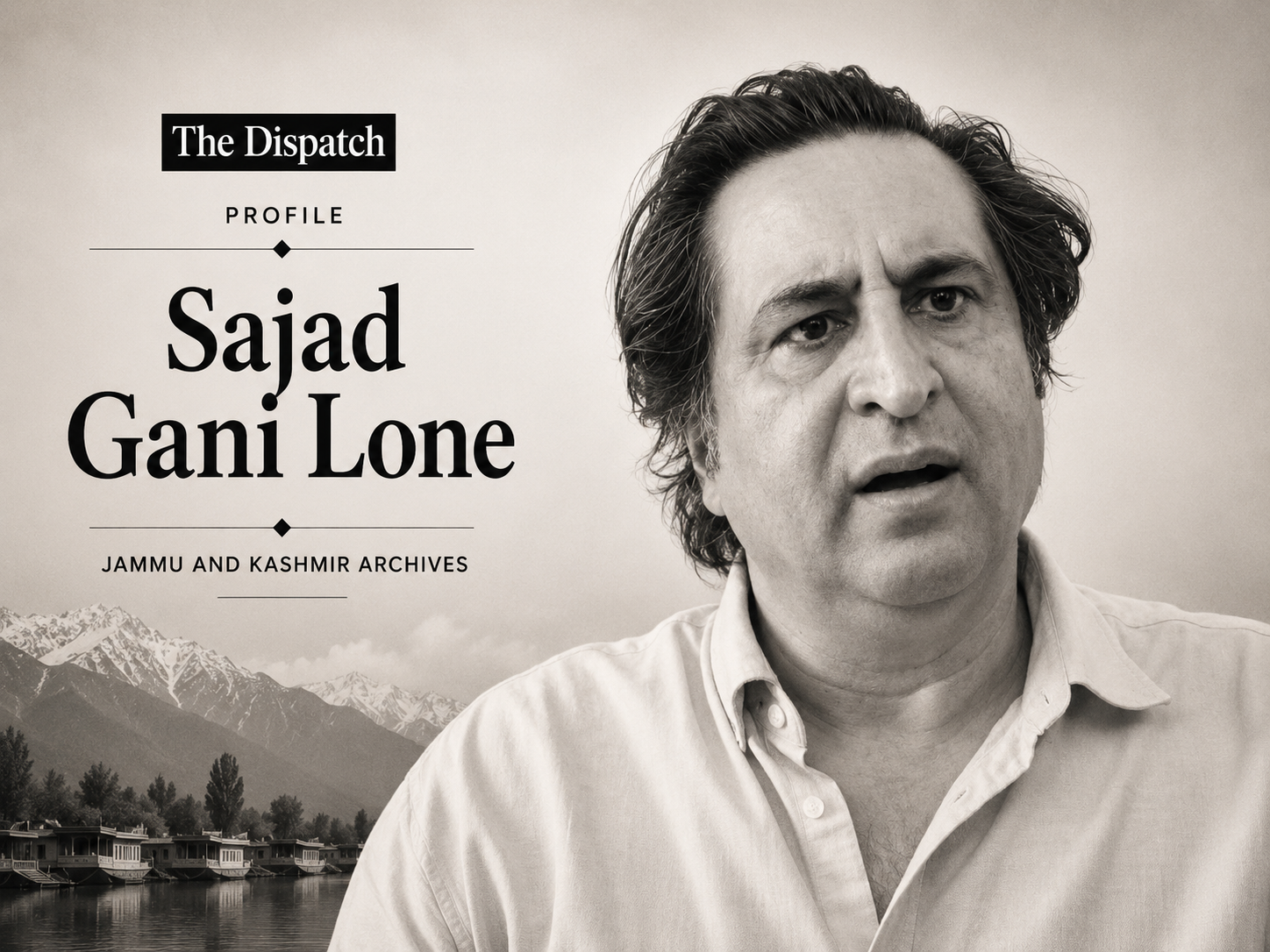
Inheritance, Rupture, and Re-entry into the Mainstream
Few political journeys in Jammu and Kashmir illustrate the pull of history and the possibility of departure as clearly as that of Sajad Lone. The son of Abdul Ghani Lone, he inherited not just a name but a political location—one rooted in separatist discourse, shaped by conflict, and marked by personal loss. What distinguishes his career is not inheritance alone, but the decision to move away from it, and to do so visibly.
Born in 1967 in Handwara, Sajad Lone’s early political identity was tied to the All Parties Hurriyat Conference, where his father had emerged as a leading voice of moderate separatism. After Abdul Ghani Lone’s assassination in 2002, Sajad stepped into a space that carried both influence and risk. For a period, he remained within the separatist framework, but his trajectory did not stay fixed. Over time, he began to reassess the limits of that politics—its capacity to mobilise without necessarily delivering outcomes—and moved toward participation within the electoral system.
This transition was neither quiet nor incremental. By reviving and reorienting the People’s Conference, he sought to build a regional platform with a base in north Kashmir, while positioning himself as an alternative to the National Conference and the PDP. The shift also required a different political language—one that combined local grounding with engagement in national politics.
Part of what enabled this repositioning was personality. Sajad Lone emerged as a charismatic and articulate public figure, comfortable with both traditional political platforms and newer modes of communication. He cultivated a following among sections of the youth over two decades, aided by his accessibility, fluency in public discourse, and active use of social media—particularly as a direct channel of communication. His public presence, often described as polished and well-informed, has been reinforced by a visible engagement with reading and current affairs, lending his politics a more argumentative and discursive tone than is typical in the region.
At the level of ideas, he attempted to move beyond binaries. His proposal described as “Achievable Nationhood” reflected an effort to articulate an “out-of-the-box” framework for resolving the Kashmir question—one that sought to reconcile competing claims through a pragmatic, negotiated arrangement rather than maximalist positions. The proposal did not become a political consensus, but it signalled his attempt to position himself not just as a participant, but as a proposer of frameworks.
His political choices have often involved risk. During the 2014 Assembly elections, when the dominant narrative among regional parties centred on preventing the BJP from entering the state’s power structure, Sajad Lone took a markedly different route. He met Narendra Modi, made the meeting public, and referred to him in personal terms—an act that cut against prevailing political sentiment in Kashmir at the time. The decision was widely seen as high-risk, both electorally and in terms of perception.
He followed this by aligning with the BJP and later joining the government in Jammu and Kashmir as a minister. This association marked a clear departure from his earlier political space, yet he managed to retain a degree of relevance within his core constituency. His politics since then has reflected a continued effort to balance regional positioning with central alignment, a combination that has become more prominent in the post-2014 and especially post-2019 political environment.
Perceptions of Sajad Lone remain divided. To some, he represents pragmatism and the willingness to engage with power structures to achieve outcomes. To others, his shift from separatist politics to alignment with the Centre remains open to question. What is less contested is that his career reflects a conscious departure from inherited positions, and a readiness to take decisions that carry immediate political cost.
Unlike earlier figures in this sequence, his trajectory is still unfolding. He operates in a political landscape that has been fundamentally altered, where traditional binaries have weakened and new configurations are still taking shape.
What sets Sajjad Lone apart is the direction of his movement. While earlier leaders travelled from engagement toward separation, his journey runs in reverse—from separation toward participation. In doing so, he represents not just a personal shift, but a broader question that continues to define Jammu and Kashmir: whether political relevance lies in remaining outside the system, or in entering it and attempting to shape it from within.
He remains active in public life, and his political path—still in motion—continues to test that question.
Leave a Reply