
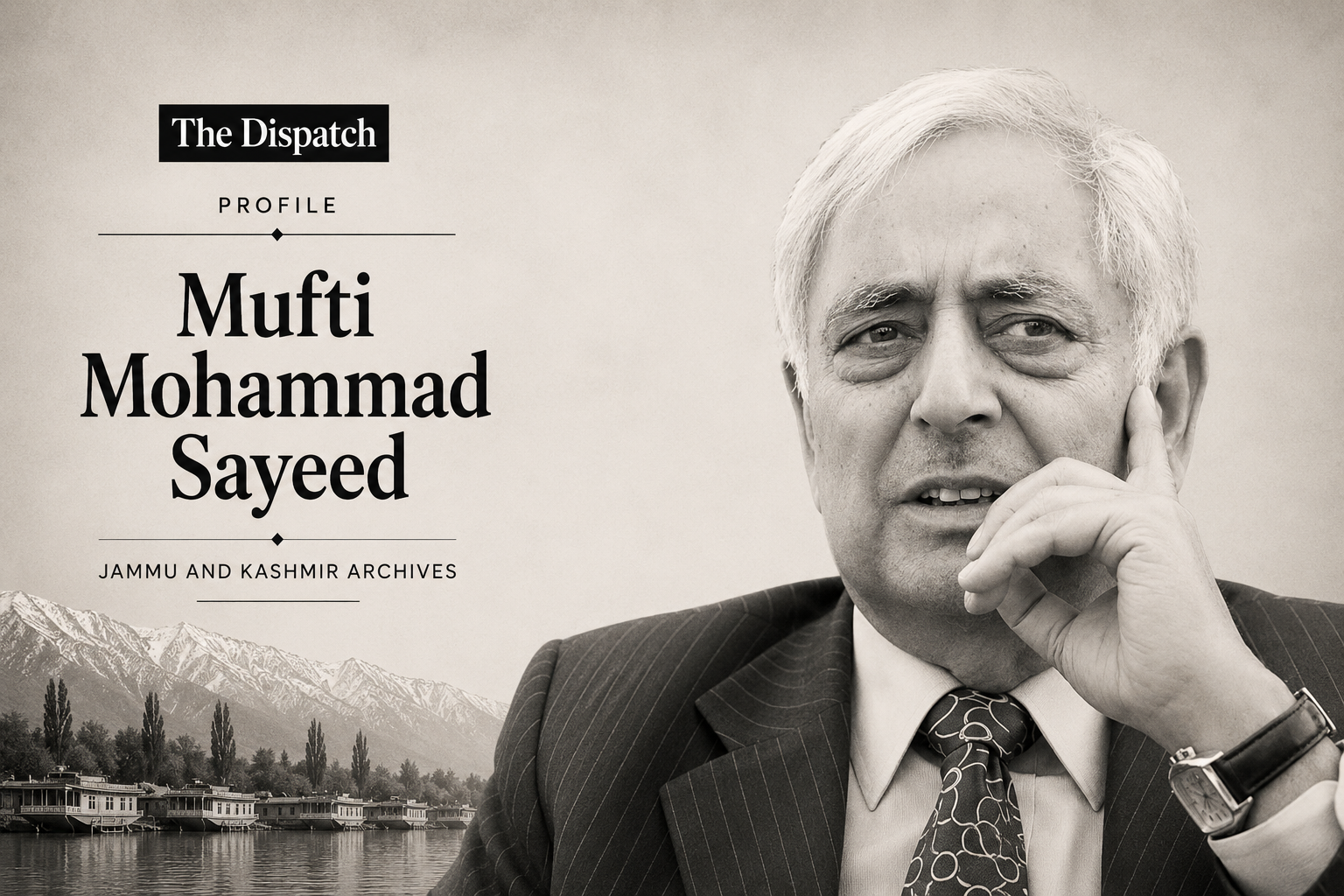
Ambition, Reinvention, and the Making of an Alternative in Kashmir
If Farooq Abdullah represented continuity within a dominant political lineage, Mufti Mohammad Sayeed represented something far more deliberate: the construction of an alternative. His career was not inherited; it was assembled—patiently, strategically, and often against the grain of established power.
Born in 1936 in Bijbehara in south Kashmir, Mufti entered active politics unusually early. He became a legislator at the age of 26, a rise often linked to the influence of Syed Mir Qasim, with whom he shared both geography and early political association. In these formative years, Mufti was not positioned as a front-ranking leader but as a young entrant navigating a crowded political field.
Contrary to later perceptions of him as a lifelong Congressman, his political beginnings were with the National Conference under Bakshi Ghulam Mohammad. He won the 1962 election on an NC ticket. It was only in 1965, during the transition under Ghulam Mohammed Sadiq, that he shifted to the Congress—beginning a long association that would define the next two decades of his career.
Through the 1960s, 1970s, and much of the 1980s, Mufti was regarded as a staunch Congressman, but his position within the party was not initially dominant. His rise required effort rather than inheritance. Coming from a background that did not automatically confer prominence, he worked steadily through the late 1960s and early 1970s to move from the margins into the centre of Kashmir’s political space.
The turning point came after Syed Mir Qasim moved to the national stage, vacating the space Mufti would soon occupy. From this moment, his politics acquired sharper definition. He began to position himself not merely within the Congress, but against the central figure of Kashmir politics—Sheikh Mohammad Abdullah.
Even after the Congress entered into an arrangement that effectively enabled Sheikh’s return to power in 1975, Mufti—by then state Congress president—did not retreat into accommodation. Instead, he turned the Congress into a form of internal opposition, challenging Sheikh’s authority consistently and publicly.
The confrontation reached a critical point in 1977. With the Congress losing power at the Centre under Indira Gandhi, Mufti moved to withdraw support to Sheikh’s government and staked a claim to form one himself. At 41, he stood on the threshold of becoming one of the youngest Chief Ministers of the state. Sheikh, however, pre-empted the move—resigning and recommending Governor’s Rule rather than allowing Mufti to assume power. The subsequent elections returned Sheikh with a decisive mandate.
For Mufti, this was not a setback that diminished ambition; it sharpened it. He emerged from this phase as a more aggressive and strategically focused leader, with a clear objective: to displace the Abdullah family as the central axis of Kashmir politics.
He remained a key player in the turbulent developments of the 1980s, including the 1984 toppling of Farooq Abdullah’s government. Yet, by the mid-1980s, the political landscape shifted again. The 1986 Rajiv–Farooq accord restored Farooq to power with Congress support, effectively sidelining Mufti’s path within the state. Rajiv Gandhi moved him to the national stage, where he was accommodated as a Union Minister—an elevation that also removed him from immediate contention in Jammu and Kashmir.
Mufti never reconciled with the Congress–National Conference alignment, which he saw as closing off his principal political route. His response was characteristic. He broke away, joining the movement led by V. P. Singh, which brought down the Congress government in 1989. In the new dispensation, Mufti became India’s first Muslim Home Minister, placing him at the centre of national power at a moment when Kashmir itself was entering a phase of militancy and upheaval. His tenure remains one of the most debated, particularly in relation to decisions taken during the early phase of insurgency.
Even this phase did not define him permanently. Demonstrating a consistent ability to read political currents, he returned to the Congress ahead of the 1996 elections, seeking once again to position himself as a challenger to the National Conference. The attempt did not yield the desired electoral outcome, but it reinforced his standing as a persistent alternative voice.
The decisive reinvention came in 1999. Breaking from national party structures altogether, Mufti founded the People’s Democratic Party (PDP)—the first credible regional alternative to the National Conference. Until then, the NC’s primary challengers had been national parties; Mufti changed that equation. Critics, particularly within the NC, alleged that the PDP’s formation had the tacit support of sections within New Delhi’s establishment, aimed at diluting NC dominance. Whether or not that perception held, the political effect was clear: the monopoly of a single regional force had been broken.
In the 2002 elections, the PDP won 16 seats in an 87-member House. It was Mufti’s political acumen that converted this into power. Securing the support of the Congress and independents, he formed the government and served as Chief Minister for three years. His tenure introduced what he described as a “healing touch” policy, aimed at softening the visible edges of conflict and restoring a degree of public confidence.
By 2008, the PDP had expanded its footprint to 28 seats, but the Congress chose to support the National Conference, partly shaped by tensions following the Amarnath land agitation. Mufti found himself once again outside power, but not outside relevance.
His final and perhaps most controversial move came in 2015. In a decision that defied ideological expectations, he aligned with the BJP to form the government. The contrast was stark: the PDP had campaigned on ideas such as “self-rule,” while the BJP had long advocated the dilution of Jammu and Kashmir’s special status. Yet Mufti proceeded, consistent with his lifelong approach of engaging across divides when it served a larger political objective.
The moment carried both symbolism and strain. Narendra Modi attended his swearing-in in Jammu, signalling the importance of the arrangement. Soon after, Mufti publicly thanked Pakistan and militant groups for allowing peaceful elections, a statement that unsettled the fragile understanding with New Delhi. Subsequent interactions reflected growing distance, and those close to him have suggested that this phase left a deep personal impact.
Mufti Mohammad Sayeed passed away in 2016.
His career does not follow a conventional arc. It is marked by entry without inheritance, rise without certainty, setbacks without retreat, and reinvention without hesitation. More than any single office he held, his lasting impact lies in reshaping the political field itself—ensuring that power in Jammu and Kashmir would no longer be organised around a single lineage, but contested through multiple, competing centres.
Leave a Reply