
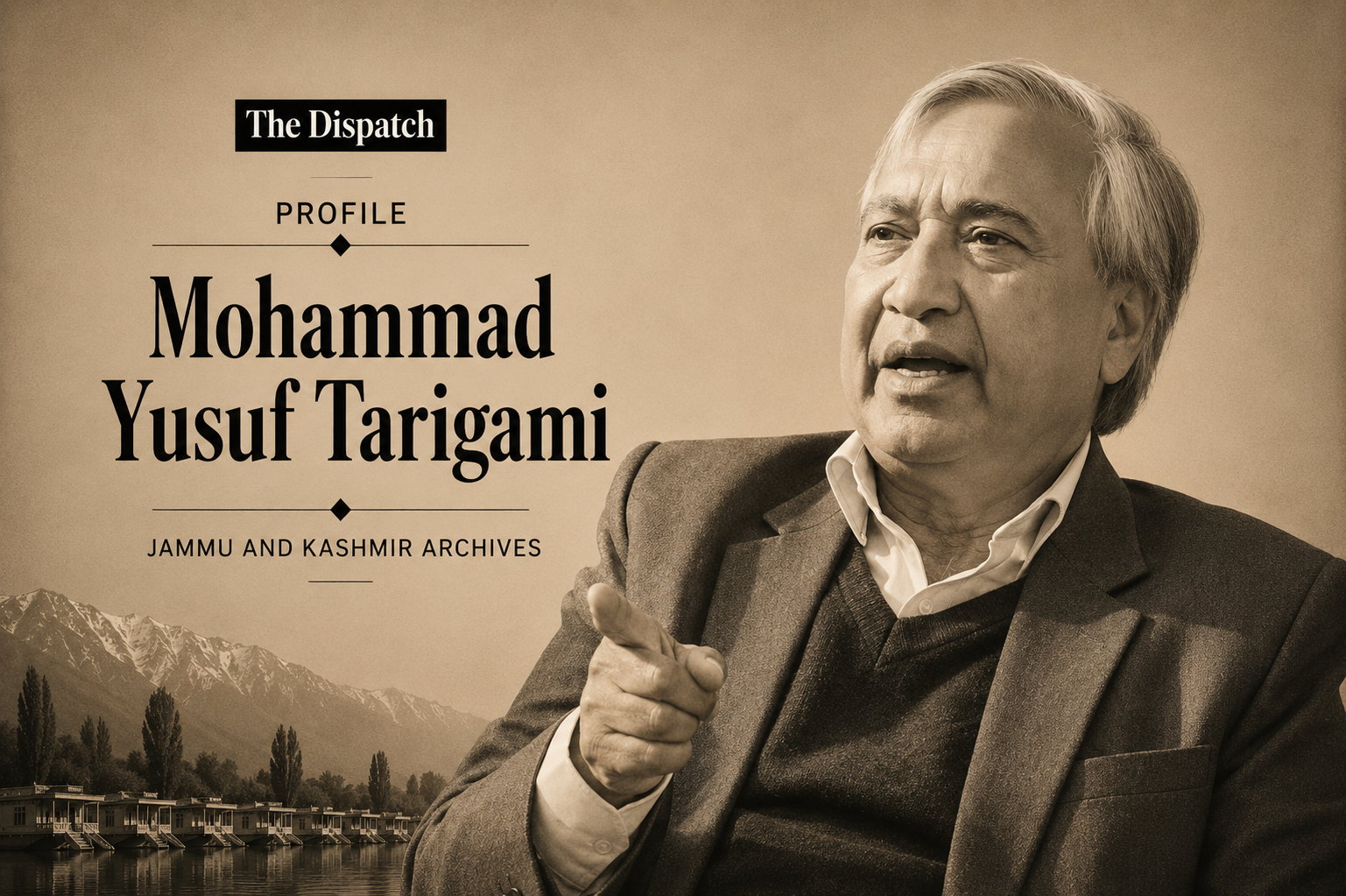
Kashmir’s Last Enduring Communist Voice
For nearly five decades, Mohammad Yusuf Tarigami — widely known as M. Y. Tarigami — has occupied a singular place in the politics of Jammu and Kashmir. In a political landscape shaped by shifting loyalties, insurgency, separatism, regional parties and ideological realignments, Tarigami remained perhaps the only enduring and recognisable Left voice to survive continuously in Kashmir’s mainstream politics.
Born in 1949 in Tarigam village of Kulgam, Tarigami emerged politically during the turbulent decades of the late 1960s and 1970s, when socialist and communist currents still retained intellectual influence in Kashmir. Drawn early toward Marxist politics, he became associated with peasant movements, student mobilisation and working-class causes. His political formation came under the influence of communist leaders such as Abdul Kabir Wani and Ram Pyare Saraf.
Tarigami first came into wider prominence during the Emergency period and the turbulent political developments that followed the 1975 Indira–Sheikh Accord. He repeatedly courted arrest and became known for uncompromising political activism. In 1979, amid unrest following the execution of Pakistan’s former Prime Minister Zulfikar Ali Bhutto, Tarigami was reportedly among the first — and quite possibly the first — political leaders to be detained under the newly enacted Public Safety Act (PSA), a law that would later become one of the most controversial instruments of security policy in Jammu and Kashmir.
Unlike many politicians in Kashmir who evolved through identity-driven or dynastic politics, Tarigami cultivated the image of an intellectually driven cadre-politician. Soft-spoken, ideologically consistent and organisationally disciplined, he remained associated with the Communist Party of India (Marxist) throughout his political life — a rarity in the fluid political culture of Jammu and Kashmir.
His greatest political achievement was survival.
In a region where communist politics gradually declined and separatist sentiment deepened, particularly across south Kashmir, Tarigami managed to retain both electoral legitimacy and ideological identity. He was first elected MLA from Kulgam in 1996 and subsequently retained the constituency repeatedly for decades, becoming one of the few politicians in Jammu and Kashmir to sustain a stable grassroots base across changing political eras.
From 1996 onward, Tarigami broadly remained aligned with mainstream governance structures and maintained working relations with successive ruling establishments, irrespective of whether power rested with the National Conference or the Congress. The notable exception came during the PDP-BJP coalition period after 2015, when he emerged as a sharper critic of the government and of the BJP’s Kashmir policy.
Yet Tarigami’s politics cannot be simplistically categorised.
He consistently advocated Kashmiri political rights, autonomy and dialogue, while simultaneously remaining firmly within the constitutional and pro-India political framework. Even at moments of heightened alienation in Kashmir, Tarigami rejected separatist politics and argued that the Kashmir issue required democratic engagement rather than military management alone.
Following the abrogation of Article 370 in 2019, he was detained once again and later emerged as one of the principal voices of the People’s Alliance for Gupkar Declaration, the coalition seeking restoration of Jammu and Kashmir’s constitutional position.
Tarigami’s long public life ultimately represents something increasingly rare in Kashmir’s politics: ideological continuity.
In a political culture often shaped by abrupt shifts, tactical alliances and emotional rhetoric, he remained grounded in class politics, constitutionalism and secular values. Whether admired or disagreed with, Mohammad Yusuf Tarigami endures as one of the last surviving representatives of Kashmir’s once-powerful Left intellectual tradition.
Leave a Reply