
Agitation, Organisation, and Access in a Centralised Political Order
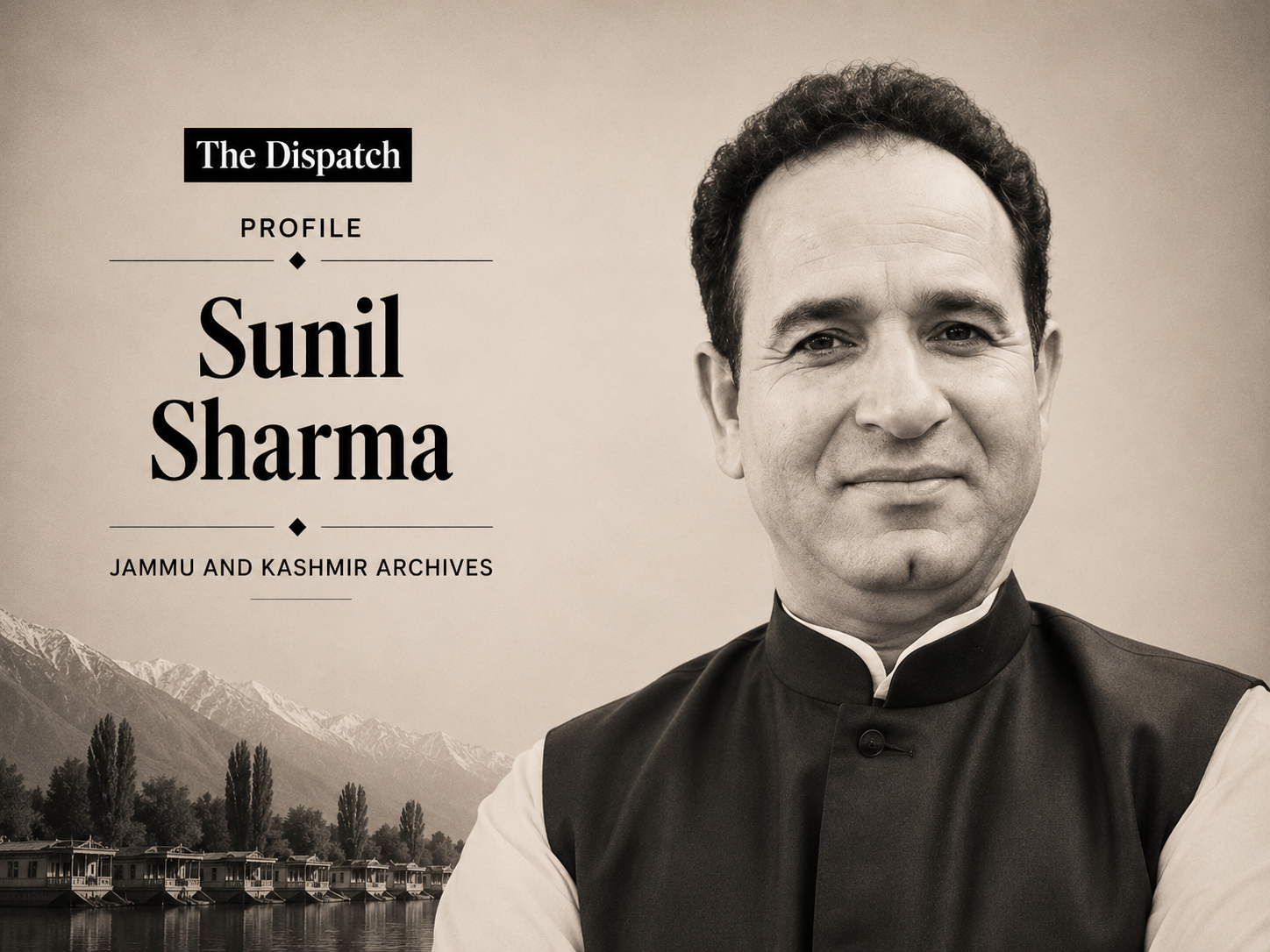
If there is one BJP leader in Jammu and Kashmir whose proximity to the Union Home Minister is most visibly signalled—often through frequent public photographs and interactions—it is Sunil Sharma, the Leader of the Opposition since 2024. In a system where access increasingly defines relevance, that visibility has become a marker of his rise.
Born in 1977 in Kishtwar, Sharma emerged from student politics within the BJP and maintained a close association with the RSS from the outset. Unlike many contemporary political figures, his trajectory was not shaped by higher education or professional credentials beyond higher secondary schooling. Instead, his political identity was forged on the ground—through issue-based mobilisation and agitational politics in a region marked by social and political complexity.
Kishtwar, his base, has historically been a Muslim-majority constituency dominated by established political families, particularly that of Sajjad Ahmed Kichloo and earlier figures like Ghulam Hassan Arman. It was in this environment that Sharma first came into prominence during the 2008 Assembly elections, when he ran a close contest against Kichloo. Though he did not win, the result marked him as a serious challenger in a constituency not naturally aligned with the BJP, altering local political equations.
He built on this momentum and, in 2014, defeated Kichloo to enter the Jammu and Kashmir Assembly. His victory was both symbolic and strategic—signalling the BJP’s ability to expand beyond its traditional base. He was inducted as a minister in the coalition government led by Mufti Mohammad Sayeed, marking his transition from agitational politics to executive responsibility.
Following the collapse of the PDP–BJP alliance and the political churn that followed, Sharma’s role evolved. The party deployed him as an organisational in-charge for Kashmir, a significant assignment given the BJP’s limited footprint in the Valley. During this phase, he worked on building grassroots contacts and established working relationships with central leaders, particularly Ram Madhav.
This period proved critical. Around the time of the 2019 transition, Sharma came into the notice of Amit Shah and was subsequently entrusted with sensitive, confidential, and high-profile assignments, indicating a level of confidence from the central leadership that few regional figures command.
His elevation as Leader of the Opposition after the 2024 elections further consolidated that trajectory. The decision was notable, as he was chosen over several more senior leaders—suggesting both generational shift and central preference.
Sharma’s political style is direct and forceful. He is widely seen as aggressive, dynamic, and effective in confrontation, particularly in legislative settings. At the same time, both within and outside party circles, he is often described as impolite and at times discourteous in his engagement with political opponents, a trait that shapes both his appeal and criticism.
His strength lies in execution rather than articulation, in organisational loyalty rather than ideological innovation. He does not position himself as a mediator across divides. Instead, he operates as a party-aligned political actor, advancing positions with clarity and without hesitation.
Sunil Sharma’s significance lies in what he represents in the current phase of Jammu and Kashmir politics: the emergence of a leadership that is grounded in organisation, trusted by the central command, and defined as much by access as by electoral success.
In a political system where Delhi has become the principal axis, figures like Sharma illustrate how proximity to power—visible, cultivated, and sustained—can itself become a form of political capital.
Leave a Reply