
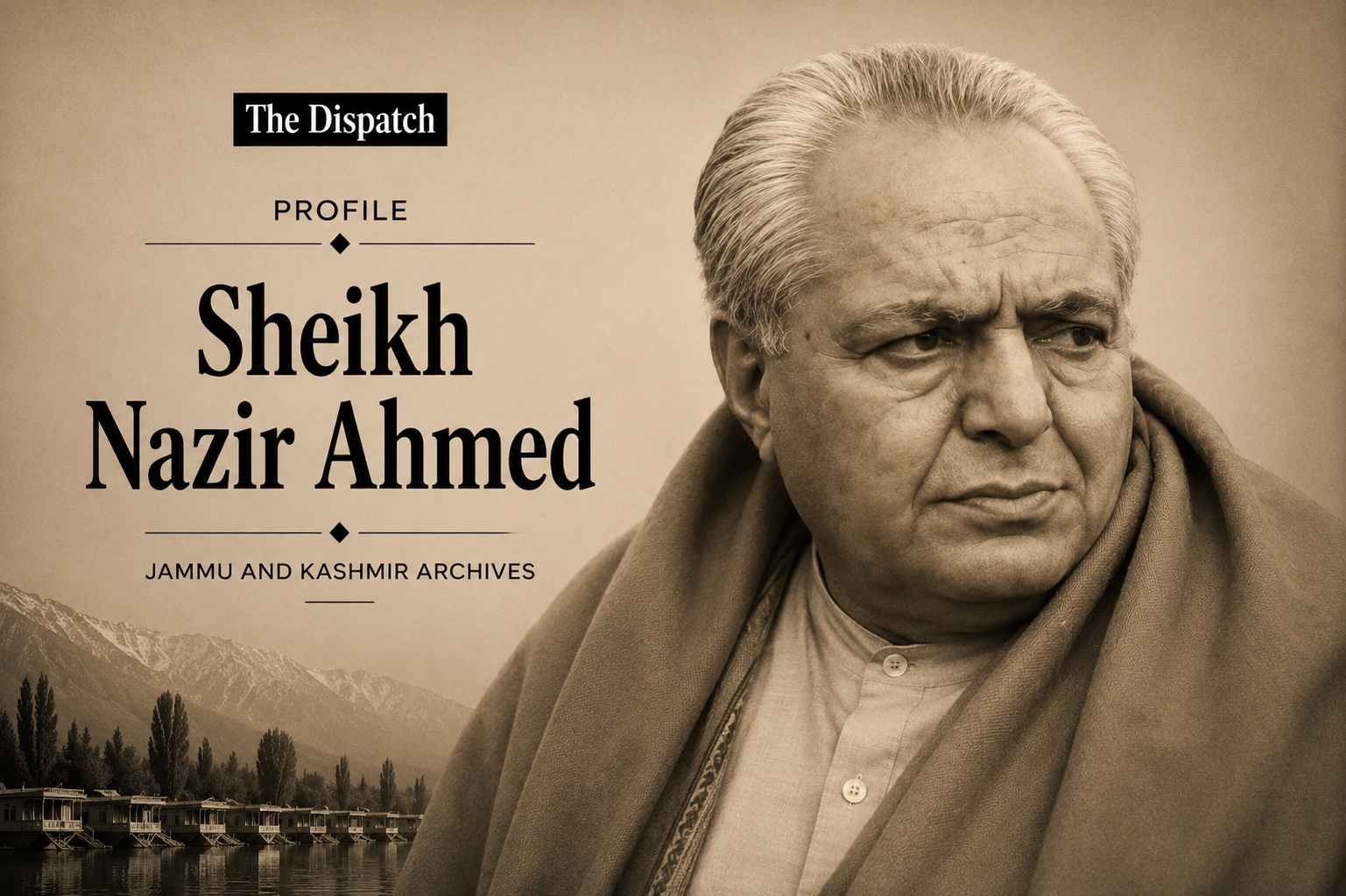
The Strategist Who Managed the National Conference from Within
In the public memory of Jammu and Kashmir politics, leaders are often remembered for speeches and mass appeal. Figures like Sheikh Nazir Ahmad operated differently—away from the podium, but close to the centre of decisions.
Born in 1936 in Srinagar, Nazir belonged to the extended family of Sheikh Mohammad Abdullah and was brought up within that political environment from an early age. Orphaned young and later raised within the Sheikh household, he grew into a role that was less visible but deeply influential.
A lawyer by training, he entered active politics through the National Conference (NC) and over time emerged as one of its most important organisational figures. For nearly three decades, he served as the party’s General Secretary, effectively acting as its internal manager and strategist.
Nazir was not a mass mobiliser. Those who worked with him often described him as a theoretician rather than a rabble-rouser—a leader who preferred to frame strategy, guide party workers, and shape internal decisions.
His influence within the National Conference was substantial. He played a central role in: managing party organisation, guiding cadre and leadership, shaping internal decision-making and preserving party records and correspondence.
For long stretches, he functioned as what many saw as the custodian of Sheikh Abdullah’s political legacy, including access to important historical documents and internal communications.
He was also known for his strong convictions on Kashmir’s political position. He consistently spoke in favour of autonomy and the preservation of Article 370, and remained critical of what he viewed as erosion of the state’s special status over time.
Unlike many of his contemporaries, Nazir maintained a certain distance from electoral politics. Accounts suggest that he never fully engaged in the electoral process, preferring to remain within the organisational core of the party rather than seeking public office.
His relationship with New Delhi was marked by scepticism, shaped in part by the events of 1953 and their aftermath. At the same time, he remained firmly within the National Conference structure, navigating its shifting alignments across decades.
He witnessed—and participated in—both phases of the party: its mass mobilisation and dominance under Sheikh Abdullah and its adaptation and compromises in later decades
In later years, as leadership patterns changed and authority shifted, his influence gradually reduced. He was eventually elevated as a senior figure within the party, but the operational role he once held diminished.
Sheikh Nazir Ahmad passed away in 2015.
He did not leave behind a mass following in the conventional sense. But for much of the National Conference’s history, he was part of the inner mechanism that kept it functioning—shaping direction, maintaining continuity, and managing its internal life across both its strongest and most uncertain phases.
Further Reading
- Greater Kashmir: Sheikh Nazir—NC’s powerful General Secretary who witnessed party’s glorious and nightmarish days
- Kashmir Life: A Different Sheikh
- Obituaries and political assessments
Leave a Reply