
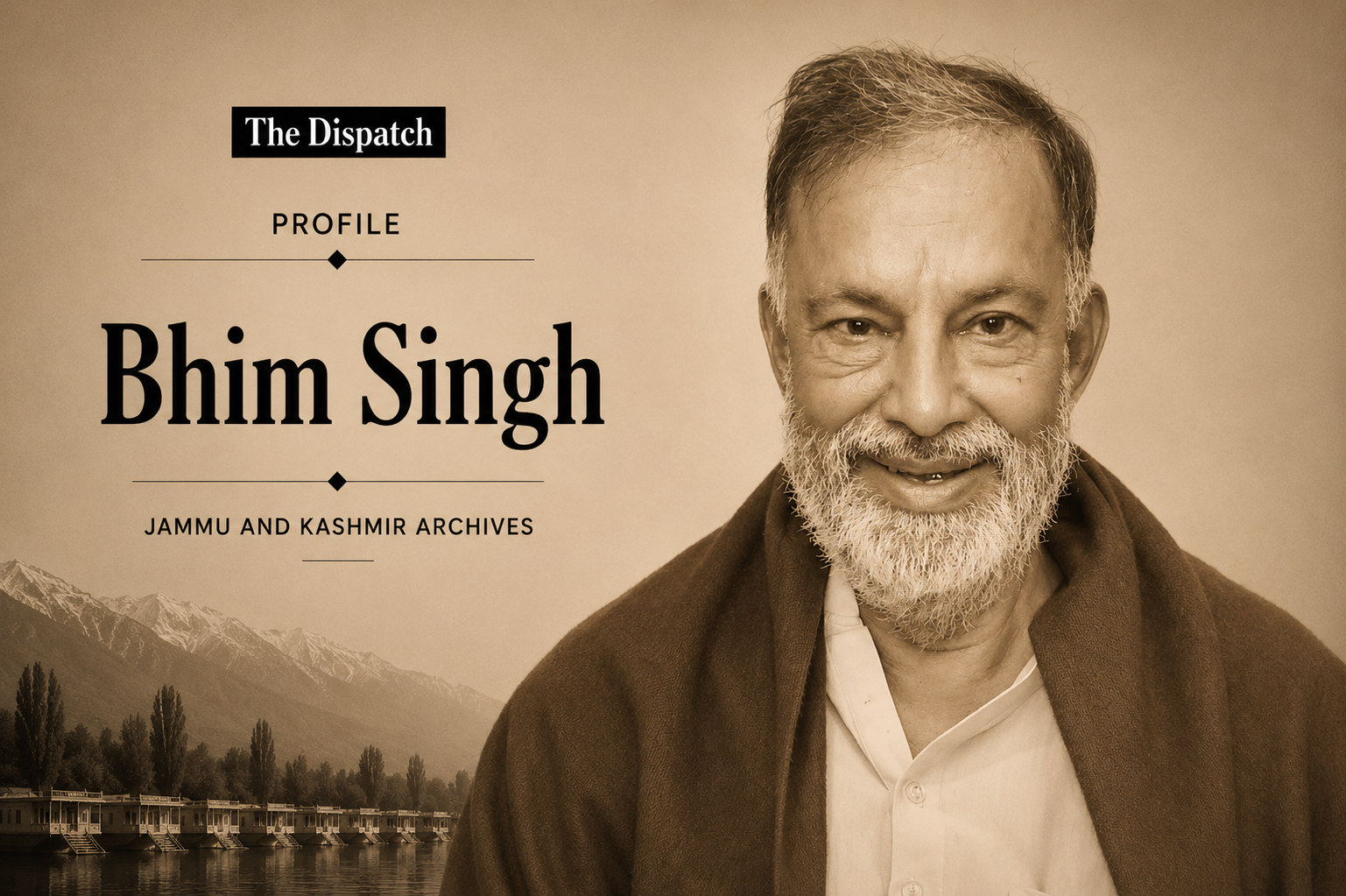
The Man Who Gave Jammu Its Own Political Voice
In the long and layered political history of Jammu and Kashmir, few leaders carved out an independent political space as distinctly as Prof Bhim Singh. At a time when the political discourse of the erstwhile state remained overwhelmingly Valley-centric, Bhim Singh emerged as perhaps the most enduring political voice from Jammu region after the dominance of the National Conference and later the Congress.
Born in 1941 in Jammu’s Udhampur region, Bhim Singh belonged to a generation that witnessed the transition of Jammu and Kashmir from monarchy to mass politics. By the time he entered public life, the political landscape of the state had already been shaped by the National Conference, which had dominated politics since the late 1930s. Even after the Congress formally expanded into Jammu and Kashmir in 1965, the principal centres of political power and mobilisation largely continued to remain in Kashmir Valley.
The decades that followed saw the rise of several regional formations — the Awami National Conference, Jamaat-e-Islami-backed politics, the People’s Conference and later the Peoples Democratic Party (PDP). Yet, almost all these parties drew their strength primarily from the Valley.
It was in this backdrop that Bhim Singh’s political journey acquired historic significance.
In the early 1980s, he founded the Jammu and Kashmir National Panthers Party, a regional formation rooted principally in Jammu region. More importantly, it survived. In a political environment where many Jammu-based parties either dissolved, fragmented or were absorbed into national formations, the Panthers Party remained politically relevant for decades and became the only durable regional political experiment to emerge from Jammu.
That alone secured Bhim Singh a permanent place in the political history of the region.
But Bhim Singh was never merely a regional politician. Trained in law and known for his sharp courtroom interventions, he cultivated an image that combined activism, constitutionalism and agitation politics. He was fiery, theatrical and often unconventional, but he was also deeply committed to parliamentary democracy and federal principles.
One of the defining features of his politics was his uncompromising secular outlook.
At a time when Jammu and Kashmir politics frequently hardened along religious, regional and ideological lines, Bhim Singh consistently projected himself as a bridge-builder. He resisted communal polarisation and repeatedly argued for coexistence between Jammu, Kashmir and Ladakh. Even his fiercest critics acknowledged that his politics carried a strong secular and constitutional core.
He was also among the rare leaders from Jammu who commanded recognition well beyond the region. Whether through protests, legal activism, human rights interventions or national television debates, Bhim Singh ensured that the political concerns of Jammu were heard in Delhi without reducing them to sectarian rhetoric.
Over the years, he became one of the most recognisable political personalities of Jammu and Kashmir — outspoken, dramatic, scholarly and fiercely independent.
In many ways, Prof Bhim Singh represented a political tradition that is increasingly rare in contemporary politics: regional in roots, national in outlook and secular in conviction.
For students of Jammu and Kashmir’s political evolution, his legacy lies not merely in electoral victories or legislative speeches, but in creating and sustaining an indigenous political platform for Jammu in a system historically dominated by larger Valley-based forces.
Leave a Reply