
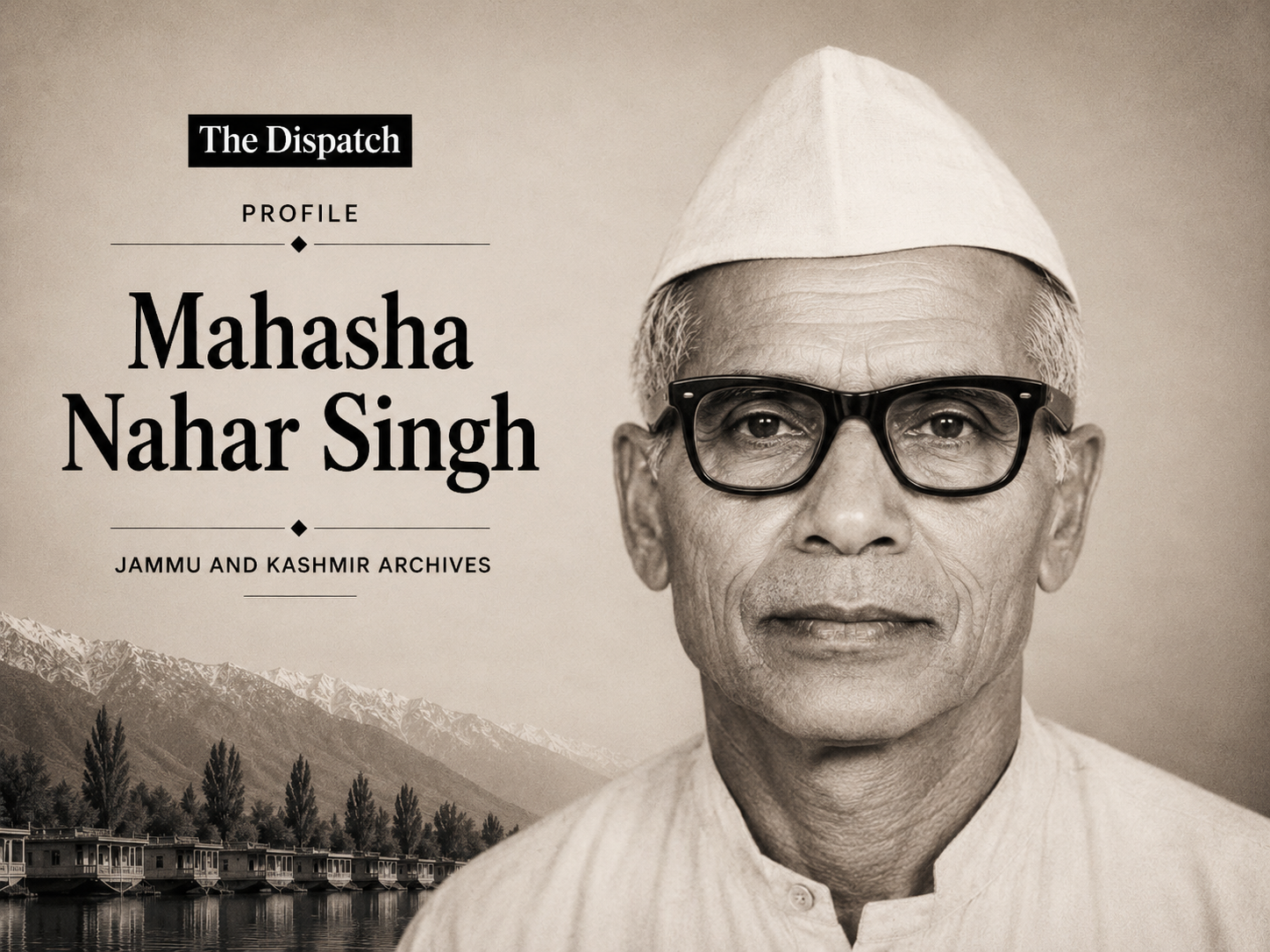
Dalit Leader, Freedom Fighter, and Champion of Social Justice in Jammu
Mahasha Nahar Singh (1899–1987) was a prominent Dalit leader, freedom fighter, and one of the earliest voices of social and political assertion among Scheduled Castes in Jammu and Kashmir. A two-time legislator and a member of the Jammu and Kashmir Constituent Assembly, he played a pivotal role in advancing the cause of the poor and downtrodden, particularly in the Jammu region.
Born into a marginalised community in Jammu, Nahar Singh rose through grassroots activism at a time when rigid caste hierarchies defined social life. His politics was rooted not in confrontation for its own sake, but in constructive social reform—aimed at uplifting disadvantaged communities while seeking broader social harmony.
He emerged as a public figure during the late Dogra period and the early years of political awakening in Jammu and Kashmir. As a freedom-era activist, he aligned himself with movements demanding political rights and representation, while simultaneously foregrounding the question of dignity and opportunity for Dalits.
Following the political changes of 1947, Nahar Singh was associated with the National Conference led by Sheikh Mohammad Abdullah in its reformist phase. He was part of a key committee constituted by the government to examine whether landlords should be compensated under the proposed land reforms—placing him at the centre of one of the most consequential socio-economic transformations in the state.
He was elected as a member of the Jammu and Kashmir Constituent Assembly from Bishnah, a role that firmly positioned him within the state’s constitutional history. His participation reflected the widening of representation beyond traditional elites and ensured that marginalised voices were present in foundational decision-making.
Nahar Singh was also elected twice as a Member of the Legislative Assembly (1951 and 1957), demonstrating both his political credibility and strong grassroots support. He remained closely connected to the communities he represented, particularly among Scheduled Castes in Jammu.
Politically, he was associated with the Praja Parishad movement, where he brought a distinct social dimension to a largely regional political platform. His presence ensured that questions of caste and social justice were not overshadowed by broader regional or ideological agendas.
He was widely regarded as a fearless and outspoken leader, often described as a “rebel” for his willingness to challenge entrenched structures. Yet his approach remained progressive and reform-oriented, focused on upliftment rather than social division. His efforts contributed to a degree of social progress in Jammu’s caste dynamics that stood out in comparison to many other parts of India during that period.
Beyond electoral politics, Nahar Singh worked extensively for the upliftment of the Scheduled Caste community, promoting education, awareness, and participation in public life.
Mahasha Nahar Singh died in 1987.
His legacy lies in his role as both a social reformer and constitutional participant—a leader who bridged grassroots activism with institutional politics. Alongside figures like Bhagat Chhajju Ram, he helped expand the social base of politics in Jammu and Kashmir, ensuring that democracy gradually included those who had long remained on the margins.
Further Reading
- Archival profiles and newspaper features on Mahasha Nahar Singh (including Sunday Times, 1977).
- Proceedings of the Jammu and Kashmir Constituent Assembly.
- Studies on land reforms in Jammu and Kashmir and debates on compensation.
- Research on caste and Dalit political mobilisation in Jammu region.
Leave a Reply