
Politics Beyond the Traditional Elite, Dalit Empowerment
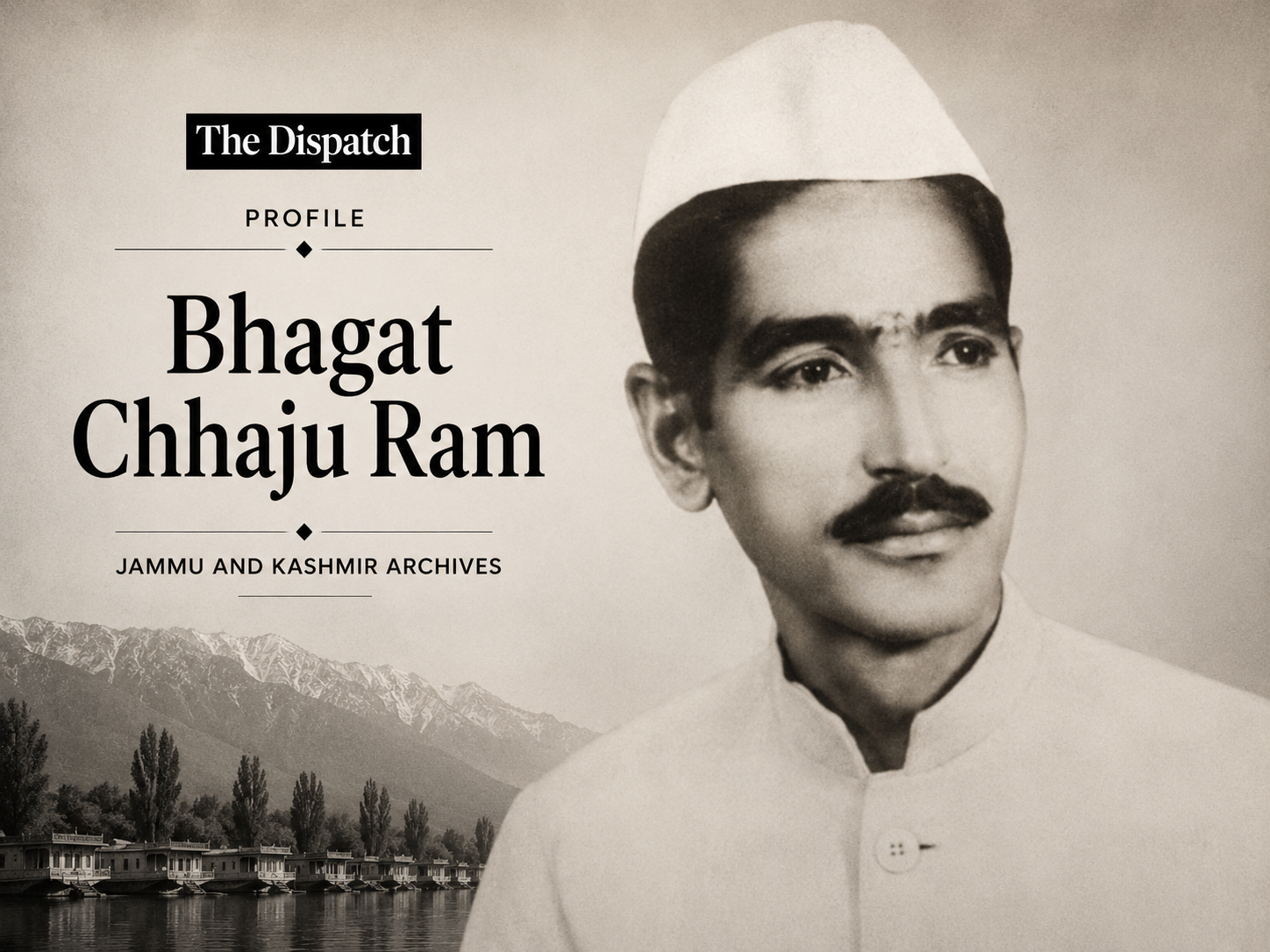
For much of Jammu and Kashmir’s early political history, public life was shaped by royalty, landed interests, religious leadership, and emerging regional elites. Voices from the Scheduled Castes rarely entered positions of visibility within the state’s formal institutions. Bhagat Chhajju Ram belonged to the first generation that began to alter that social composition from within.
Born on 7 March 1907 in R.S. Pura into the Megh community, Chhajju Ram emerged from modest circumstances at a time when caste hierarchies remained deeply entrenched in Jammu society. His rise into public life was therefore not merely political; it represented movement across structures that had long remained socially closed.
His early political career began during the later years of Dogra rule, when he was elected to the Praja Sabha, the legislative institution of the princely state. Even in limited form, this carried significance. The entry of leaders such as Chhajju Ram into representative institutions reflected the gradual widening of political participation beyond established social elites.
The political transformation after 1947 shaped his ideological direction in decisive ways. Like many among the socially disadvantaged sections of the state, he was drawn toward the programme of the Sheikh Mohammad Abdullah and the National Conference, particularly its land reforms. The redistribution of land weakened older social hierarchies and granted ownership rights to cultivators from communities that had historically remained economically and socially dependent. For leaders like Chhajju Ram, these reforms carried meaning beyond economics—they represented dignity, recognition, and entry into a new political order.
His association with the National Conference brought him into the Jammu and Kashmir Constituent Assembly, placing him within the foundational phase of the state’s constitutional evolution. In these years, his political significance rested less on rhetoric and more on presence itself: the fact that communities historically confined to the margins were beginning to find space within institutions of governance.
The political restructuring of the mid-1960s, particularly the merger of the National Conference into the Congress framework, led Chhajju Ram into the Congress, where he remained an influential figure for many years. He built a reputation as an accessible grassroots leader whose standing depended less on ideological positioning and more on sustained engagement with ordinary people in rural Jammu.
Like many politicians of his generation in Jammu and Kashmir, his career also reflected the fluidity of political alignments within the state. In the late 1970s, during a period of internal political churn, he briefly joined Mirza Afzal Beg after the latter broke away from Sheikh Abdullah to form the Revolutionary National Conference. The experiment, however, failed to create durable political space, and Chhajju Ram eventually returned to the Congress fold.
What remained constant through these shifts was his social commitment. He continued to advocate for the upliftment of Scheduled Caste communities and worked to increase their participation in political and public institutions. His politics did not carry the dramatic edge of mass agitation or ideological confrontation, yet it contributed quietly to an important transformation taking place within Jammu and Kashmir: the expansion of democracy beyond its traditional social boundaries.
Even in the later years of his life, he retained electoral relevance, winning election to the Legislative Assembly in 1987. His influence extended into the next generation as well, with his daughter-in-law Suman Bhagat later entering the Assembly and serving as a minister.
Bhagat Chhajju Ram’s importance lies not in commanding the centre of political power, but in helping widen access to it. In a political history often narrated through dynasties, ideological conflicts, and regional contestation, his journey reflected another quieter process unfolding alongside them—the gradual inclusion of historically marginalised communities into the language of representation, governance, and public dignity.
Leave a Reply