
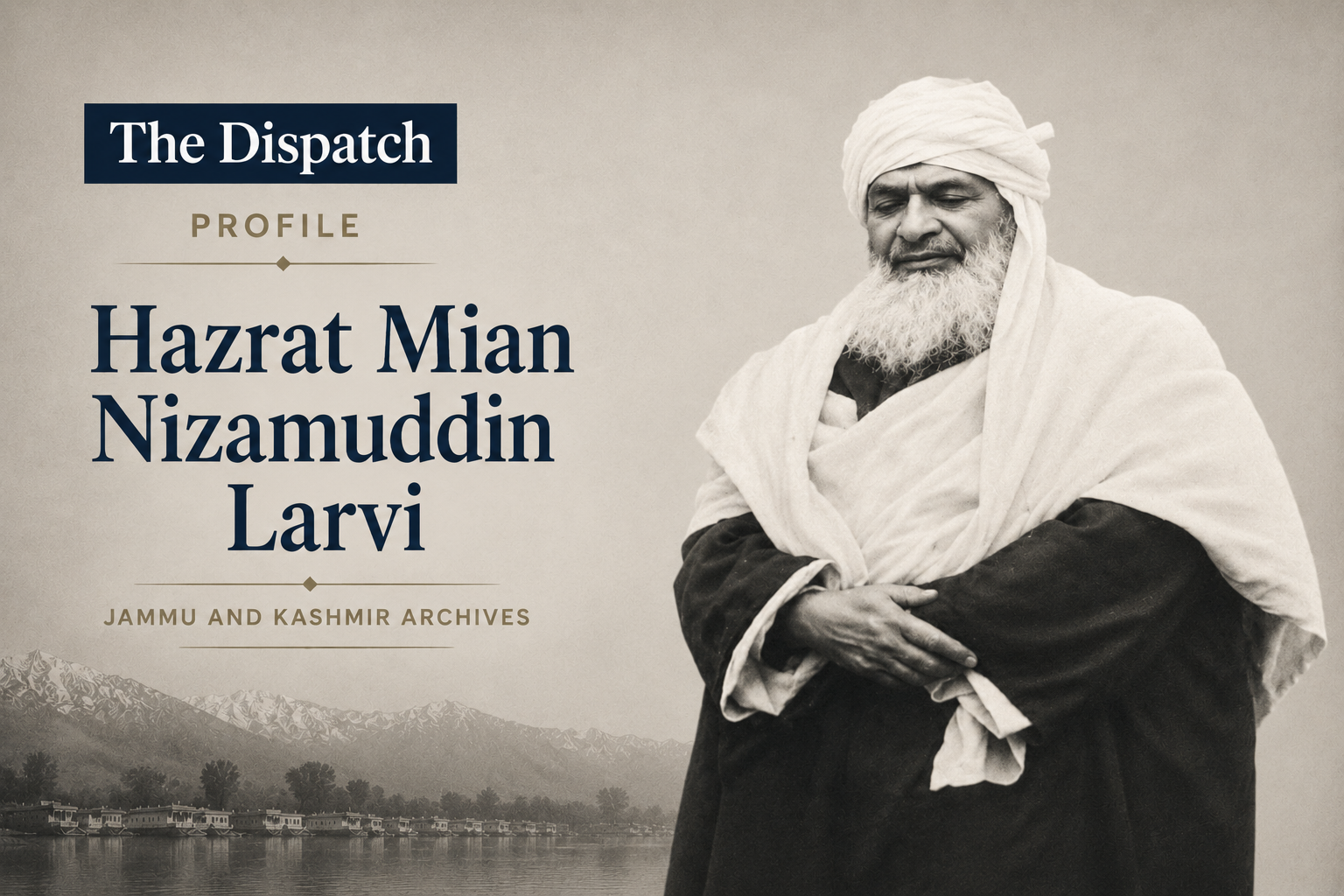
Spiritual Authority and the Voice of the Margins
Mian Nizam-ud-Din Larvi belonged to a strand of Jammu and Kashmir’s public life that rarely occupied the centre of formal politics, yet exercised deep influence across society. A Sufi leader, social reformer, and political representative from the Lar–Wangat belt of central Kashmir, he emerged as one of the earliest voices to organise and articulate the aspirations of the Gujjar–Bakarwal community within the evolving political structure of the state.
Born in April 1892 at Haritji-Wangat to the Sufi saint Hazrat Mian Abdullah, popularly known as Baba Ji, he inherited a spiritual lineage rooted in the Chishti tradition. Initially named Mian Abdul Latief, he later came to be known as Mian Nizam-ud-Din after the revered Sufi saint Hazrat Nizam-ud-Din Kayanavi. The suffix “Larvi,” derived from Lar, remained associated with the family’s spiritual identity and continues to carry influence across Kashmir, particularly among Gujjar and rural communities.
Unlike many political figures of his time, his authority did not emerge from agitation, office, or party structures. It came from spiritual standing, scholarship, and social engagement. Educated in Arabic, Persian, and Urdu under traditional scholars, he developed a deep engagement with religious texts while also cultivating familiarity with Sufi poetry and folk traditions. Importantly, he communicated not only in elite literary languages but also in Punjabi and Gojri, enabling him to connect with pastoral and tribal populations that remained distant from formal institutions.
His public work acquired significance in the context of marginalisation. In the early twentieth century, Gujjar–Bakarwal communities remained largely outside the structures of education, administration, and political representation. Even the reforms and recommendations emerging from the political churn of the 1930s did little to address their concerns. It was in this environment that Mian Nizam-ud-Din Larvi became associated with the formation of the Gujjar–Jat Conference in 1932, among the earliest organised attempts to articulate the interests of these communities.
At the same time, he built a wider social movement through Gujjar Welfare Committees, public gatherings, and spiritual outreach. His approach was not confrontational; it was reformist and integrative. Using folk narratives, Sufi teachings, and accessible language, he encouraged education, social discipline, and collective awareness among communities that had historically remained on the margins of political life.
What distinguished him most, however, was the manner in which he connected spirituality with political belonging.
As a member of the Jammu and Kashmir Constituent Assembly, Mian Nizam-ud-Din delivered a significant intervention during debates surrounding the state’s constitutional future. At a time when accession and identity were deeply contested questions, he advanced a spiritual and civilisational argument for Jammu and Kashmir’s association with India. Referring to Khwaja Moinuddin Chishti and Hazrat Nizamuddin Auliya—among the most revered figures in the spread of Islam in the subcontinent—he argued that when the resting places of such saints were in India, it was neither natural nor meaningful to define political destiny purely through the logic of religion. Coming from a Muslim Sufi leader of high standing and from a historically marginalised Gujjar background, the intervention carried unusual significance. It represented an articulation of belonging rooted not in statecraft or ideology, but in spiritual continuity and shared civilisational space.
His standing eventually translated into electoral politics as well. He served in the Praja Sabha during the princely era and later represented Kangan in the Jammu and Kashmir Legislative Assembly, winning elections in 1957, 1962, and 1967. Yet, even while holding office, he remained primarily identified as a spiritual figure rather than a conventional politician. His centre at Lar—Darbar-e-Lar—evolved into a major spiritual and social institution visited by political leaders, scholars, poets, and ordinary devotees alike.
The influence he built outlived him. Through his son Mian Bashir Ahmad and later through Mian Altaf Ahmad and Mian Mehar Ali, the family retained an enduring presence in the public life of Jammu and Kashmir. Yet the continuity of that influence rested not merely on electoral success, but on the moral and spiritual capital that Mian Nizam-ud-Din Larvi had accumulated over decades.
His significance lies in the fact that he brought into structured public life communities that had long remained peripheral, while doing so without abandoning the language of spirituality, cultural rootedness, and social harmony. In a political history often dominated by power struggles and ideological confrontation, he represented a quieter but deeply influential current—one in which faith became not a basis for division, but an argument for coexistence and belonging.
Leave a Reply