
Loyalty, Resistance, Return to Power, and the Fallout
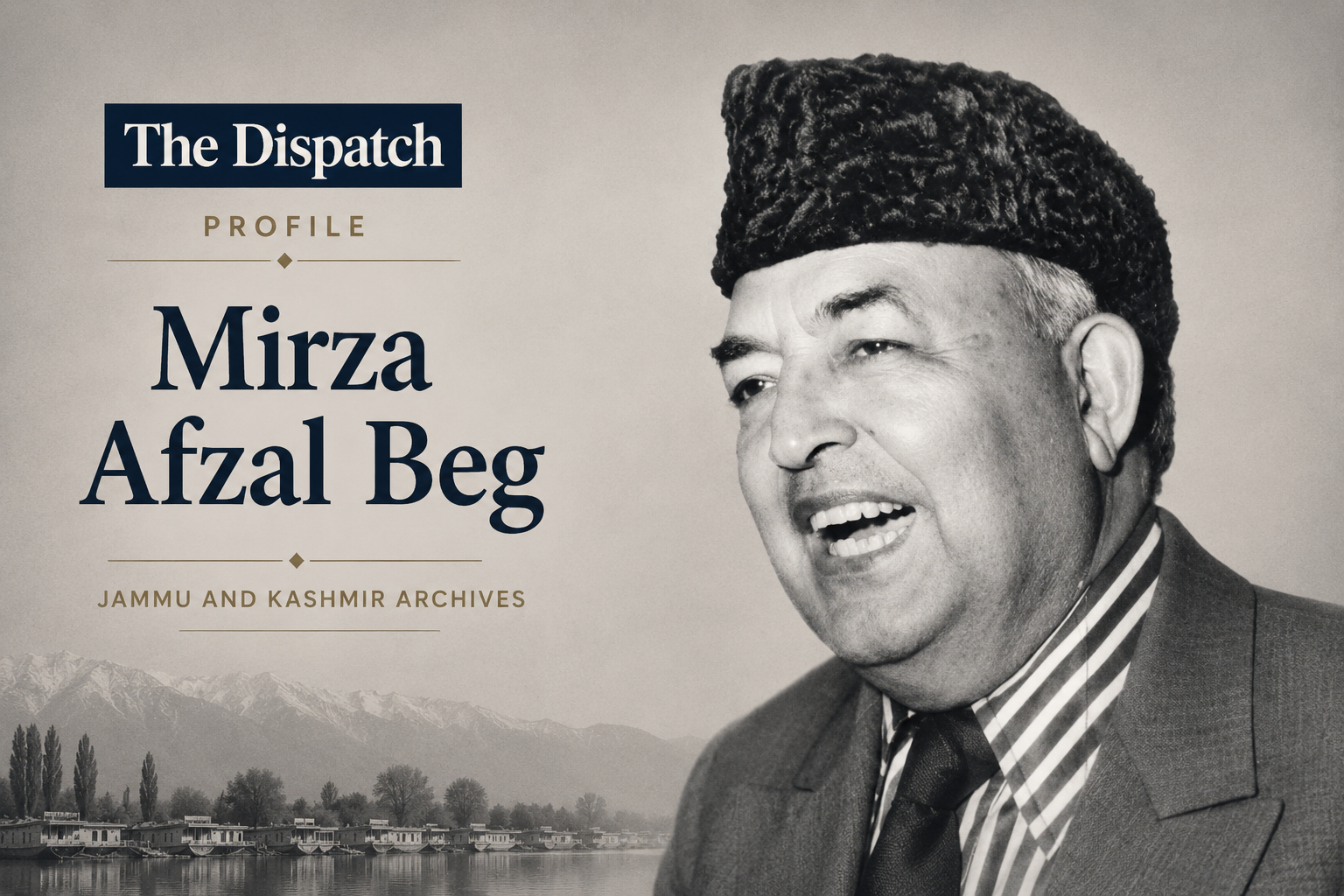
Mirza Afzal Beg was, for much of his political life, inseparable from Sheikh Mohammad Abdullah. If Sheikh was the public face of Kashmir’s political movement, Beg was its most steadfast organiser, strategist, and interpreter—a man whose influence lay as much in his intellect as in his unwavering loyalty.
Born in 1908 in Anantnag and trained in law, Beg brought to politics a rare combination of legal clarity and administrative understanding. From the 1930s onward, he emerged as one of Sheikh Abdullah’s closest associates, playing a central role in building the National Conference into a disciplined and effective political organisation. His command over revenue and legal matters gave him a distinct authority within the leadership.
After accession in 1947, Beg became a key member of the government led by Sheikh Abdullah and served as Revenue Minister. It was in this role that he left one of the most enduring marks on the region’s history. As the principal architect of the Big Landed Estates Abolition Act, he helped dismantle feudal land ownership and transfer land to cultivators—a reform that fundamentally reshaped the socio-economic structure of Kashmir and consolidated the political base of the National Conference.
The events of August 1953 marked a decisive test of political loyalty.
When Sheikh Abdullah was dismissed and arrested, much of the political establishment distanced itself from him. Beg did not. He stood by Sheikh at a moment when loyalty carried real consequence. Arrested and made a co-accused in the Kashmir Conspiracy Case, he spent years in prison, emerging as the most visible symbol of resistance within Sheikh’s camp.
Out of that period came his most defining political role. In 1955, Beg founded the Plebiscite Front, which became the principal platform advocating the right of the people of Jammu and Kashmir to determine their political future. For nearly two decades, he sustained this movement, keeping alive a political position that stood in direct opposition to the ruling establishment.
Yet Beg’s politics was not confined to resistance alone. By the early 1970s, he recognised that the political landscape had shifted. India’s position had strengthened after the 1971 war, and the space for alternative outcomes had narrowed. As the principal interlocutor with New Delhi, he played a central role in the negotiations that led to the 1975 accord between Sheikh Abdullah and Indira Gandhi, facilitating Sheikh’s return to power within the constitutional framework of India.
In doing so, Beg traversed a rare political arc—from architect of reform to prisoner, from resistance leader to negotiator of settlement. It was a journey shaped as much by conviction as by his ability to read changing circumstances.
The final phase of his life brought an unexpected turn. Despite decades of shared struggle, differences emerged between him and Sheikh Abdullah. In 1978, he broke away and formed the Revolutionary National Conference. The move, though politically limited in its outcome, marked the end of one of the most enduring partnerships in Kashmir’s political history.
By the time Mirza Afzal Beg’s political journey drew to a close in 1982, the arc he had travelled had already left a lasting imprint on the region’s politics. He had helped shape its most transformative reform, sustained its longest phase of political resistance, and ultimately enabled a return to power on altered terms. If Sheikh Abdullah gave the movement its voice, Beg ensured that it endured—and, when the moment demanded, guided it through transition rather than collapse.
Leave a Reply