
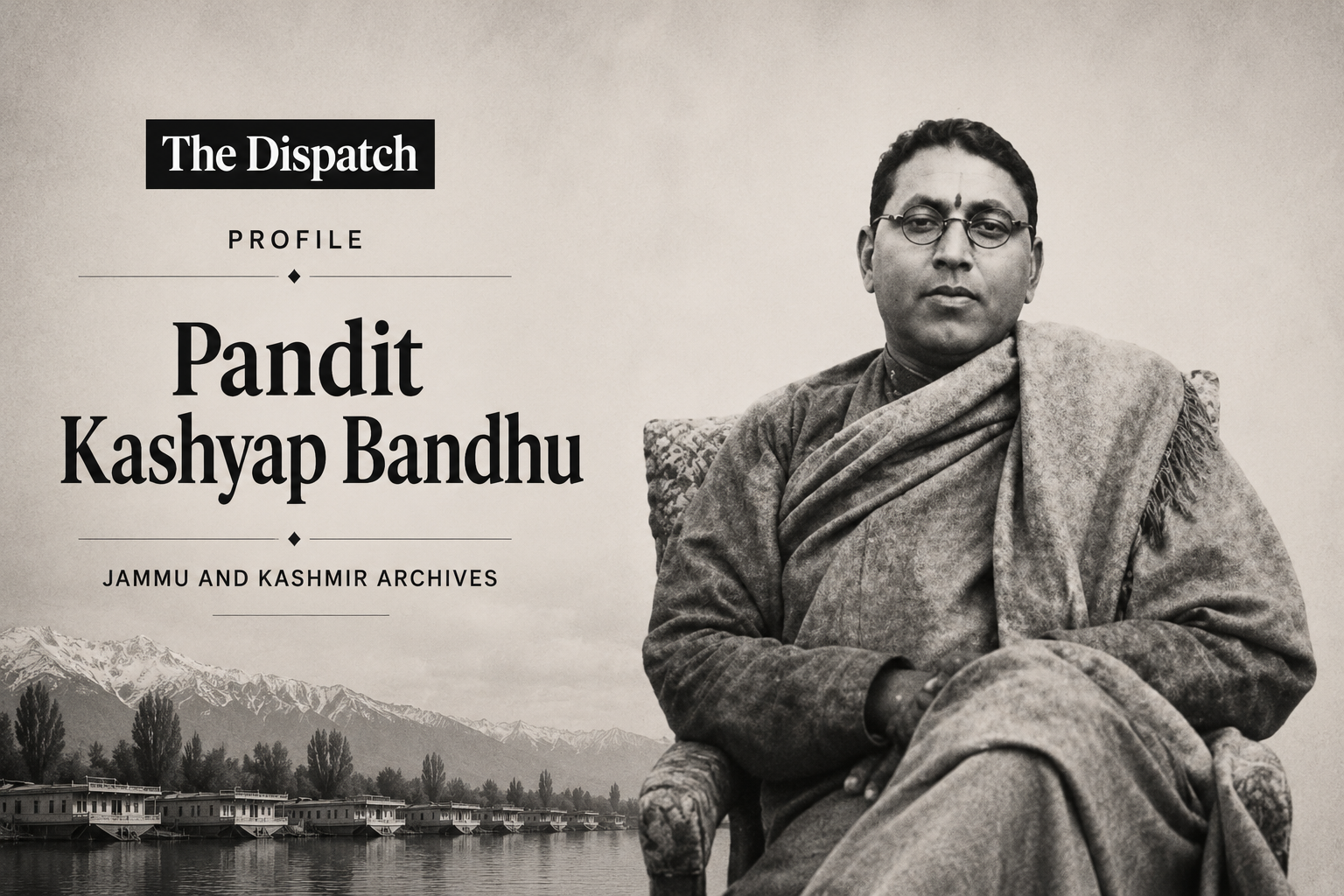
Social Reformer, Early Political Activist, and Bridge in Kashmir’s Reform Movements
Kashyap Bandhu, born in 1899 in Srinagar, was among the earliest Kashmiri Pandit leaders to engage actively with the social and political transformation of Jammu and Kashmir in the early twentieth century. A reformist by orientation and a political activist by conviction, Bandhu played a significant role in shaping the intellectual and social currents that preceded and accompanied the rise of organised mass politics in the region.
Educated in Lahore, Bandhu was influenced by broader currents of reform, nationalism, and social change that were sweeping across India in the early decades of the twentieth century. Upon his return to Kashmir, he became associated with movements aimed at addressing social inequalities, educational backwardness, and the need for political awakening within Kashmiri society.
He emerged as a key figure in the establishment and activities of the Kashyap Bandhu-led reform initiatives, which sought to mobilise the Kashmiri Pandit community beyond traditional confines and engage it with wider political developments. At a time when sections of the Pandit elite were aligned with or dependent on the Dogra administration, Bandhu represented a departure—advocating reform, modern education, and broader political participation.
Bandhu’s role during the agitation of 1931 and the subsequent political developments is particularly noteworthy. While the movement was largely driven by grievances within the Muslim population, Bandhu was among those who recognised the need for cross-community engagement and reform. His position reflected an understanding that political stability and progress in Jammu and Kashmir required participation from all sections of society.
In the years that followed, Bandhu became associated with emerging political platforms, including early iterations of organised political activity that would later evolve into larger movements. He is often regarded as one of the Kashmiri Pandit leaders who maintained engagement with the broader political discourse rather than retreating into community-specific politics.
Bandhu also remained active in public life through social work, advocacy, and intellectual engagement. His efforts contributed to the spread of education and social awareness, particularly within the Kashmiri Pandit community, encouraging a shift toward modern professions and public participation.
Unlike later political figures who held formal positions of power, Bandhu’s influence was less institutional and more societal. He operated as a reformer, organiser, and intermediary—helping to bridge social divides at a time when political identities were still in formation.
His legacy is therefore not tied to a single office or event but to a broader contribution in shaping the early discourse of reform and participation in Jammu and Kashmir. He represents a strand of Kashmiri Pandit leadership that was outward-looking, reform-oriented, and engaged with the larger political transformation of the state.
Kashyap Bandhu died in 1986.
In retrospect, his role acquires added significance. As later decades witnessed sharper communal and political divisions, Bandhu’s efforts at cross-community engagement and reform stand out as part of an earlier phase when shared political space was still being negotiated. His life underscores the presence of Kashmiri Pandit participation in the formative years of Kashmir’s modern political awakening—an aspect that is sometimes underrepresented in broader narratives.
Further Reading
- Kashmir’s Transition to Democracy, 1931–1947 — Context on early political movements and reformist currents.
- Contemporary writings and archival material on early reform movements in Kashmir (1920s–1940s).
- Regional newspaper archives and memoir-based accounts referencing early Kashmiri Pandit reformers.
Leave a Reply