
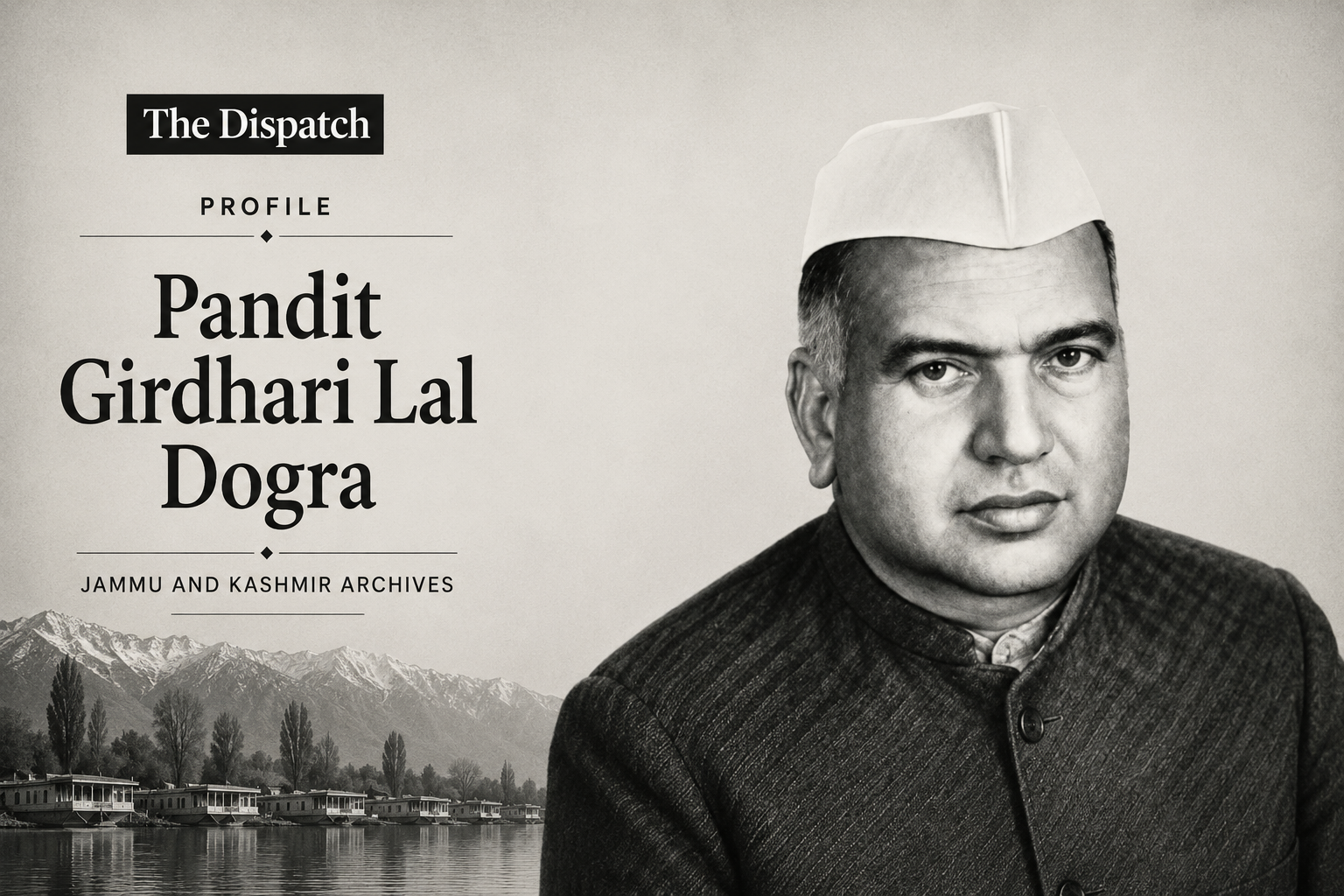
Early National Conference Leader; Finance Minister; Bridge Figure from Jammu
Pandit Girdhari Lal Dogra, born on 1 July 1915 in Jammu, was among the most enduring political figures of Jammu and Kashmir in the decades following Independence. A senior leader of the National Conference and a long-serving Finance Minister, Dogra occupies a distinctive place in the region’s political history as a representative voice from Jammu within a political formation largely rooted in the Kashmir Valley.
Educated in Jammu and Lahore, Dogra entered public life at a time when political currents in the state were undergoing rapid transformation. In contrast to prevailing trends in Jammu—where sections of opinion were aligned with the Dogra monarchy or later the Praja Parishad—Dogra aligned himself early with the National Conference and developed a close association with Sheikh Mohammad Abdullah by the early 1940s. This placed him against the dominant political current in his region and marked him out as a leader willing to operate across regional and ideological lines.
In 1947, during the critical phase of transition following accession, Dogra became part of the Emergency Administration set up under Sheikh Abdullah. From this point onward, he remained continuously in positions of authority for nearly three decades, making him one of the longest-serving figures in the state’s political establishment.
Dogra is best remembered for his role as Finance Minister of Jammu and Kashmir, a position he held for an extended period across successive governments. He played a central role in shaping the state’s fiscal framework, planning priorities, and development strategies during a formative phase of governance.
In the early years, Dogra was widely regarded as part of a group of influential leaders within the National Conference that included G. M. Sadiq and D. P. Dhar. At the time, international and domestic attention focused on what was perceived as a “communist influence” within sections of the Kashmir leadership. A prominent American publication described this group as having communist leanings and suggested that they had gained significant influence within the National Conference government. This characterisation resonated within official circles in India as well, particularly in the early Cold War context when ideological alignments carried strategic implications.
These concerns reached the highest levels of the Indian leadership. Following intelligence inputs, President Rajendra Prasad is understood to have sought clarification from Prime Minister Jawaharlal Nehru regarding the perceived communist influence within the Jammu and Kashmir leadership. Nehru, in his response, defended these leaders, suggesting that their orientation was linked to shaping progressive social and economic policies rather than any subversive ideological agenda. The episode reflects the sensitivity of ideological debates in Kashmir’s early political evolution.
Despite his close association with Sheikh Abdullah, Dogra was not merely a passive participant in the events of 1953. He was among the key figures involved in the political process that led to Sheikh Abdullah’s dismissal and arrest in August 1953. This marked a decisive rupture in the leadership structure of the state and reshaped the trajectory of Jammu and Kashmir’s politics. Dogra continued to hold positions of influence in the post-1953 order and remained a central figure in governance.
His political career is notable for its continuity. Across changing administrations and shifting political alignments, Dogra remained part of the ruling establishment, reflecting both his administrative importance and political adaptability. Unlike mass leaders who commanded broad popular mobilisation, his influence was primarily institutional and policy-driven.
When Sheikh Abdullah returned to power in 1975 following the accord with the Government of India, the political environment shifted once again. In this phase, Dogra gradually moved away from active politics in Jammu and Kashmir and transitioned to parliamentary life at the national level, marking a quiet but significant shift in his career.
Pandit Girdhari Lal Dogra died in 1987.
His legacy lies in his role as a bridge figure—between Jammu and Kashmir, between regional identity and state-wide politics, and between ideology and administration. He represents a strand of leadership that operated within institutions while remaining closely connected to the most critical turning points in the state’s political history.
In a later generational link, his family remained connected to national public life; his daughter was married to Arun Jaitley, who went on to serve as a senior leader in the Bharatiya Janata Party and as a Union Minister in successive governments.
Leave a Reply