
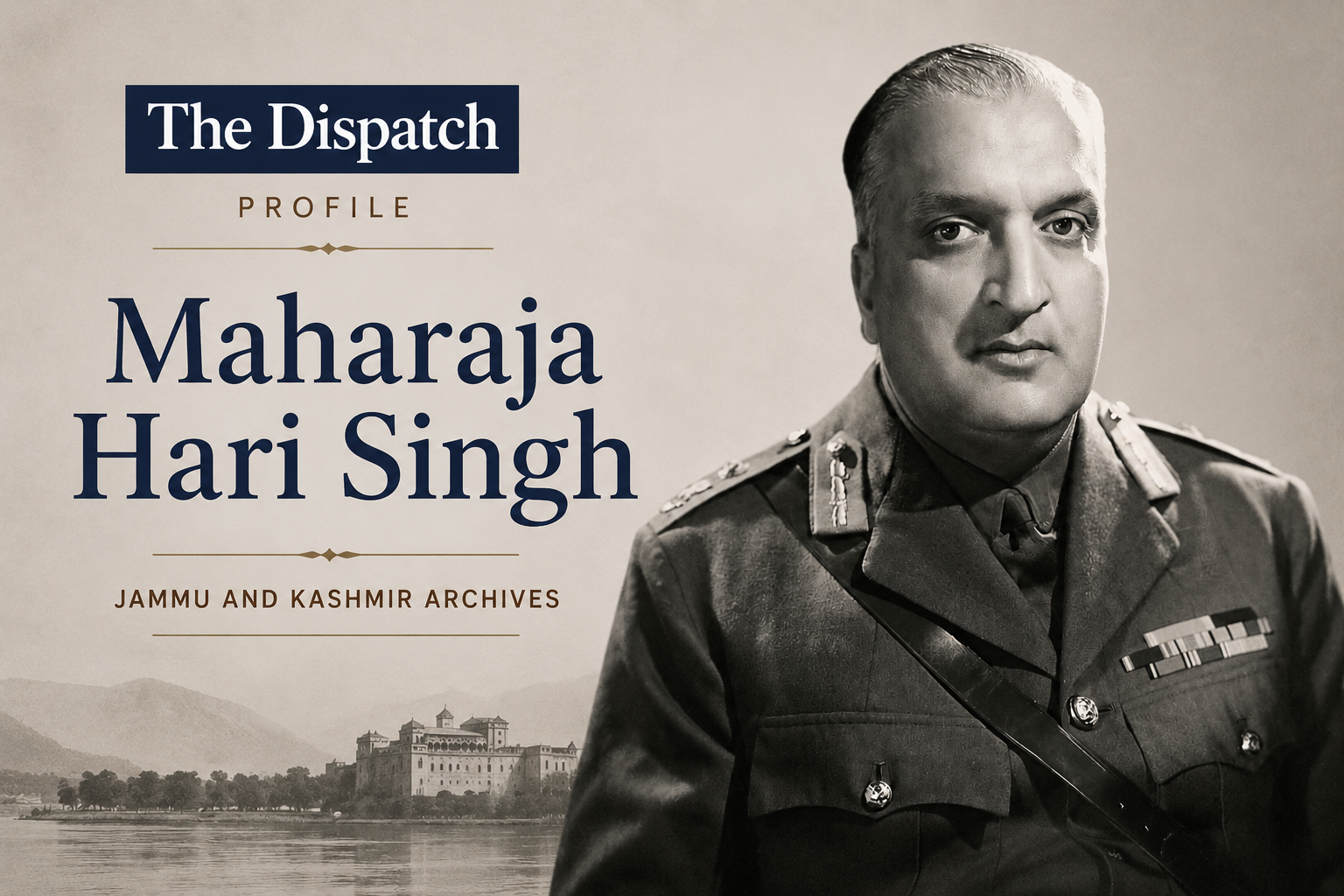
Last Ruler of the Princely State of Jammu and Kashmir
Maharaja Hari Singh was born on 23 September 1895 into the Dogra royal family, the son of Raja Amar Singh and nephew of Maharaja Pratap Singh. Following his father’s early death, he was brought up under state supervision and groomed for leadership. He was educated at Mayo College, Ajmer, and later trained at the Imperial Cadet Corps in Dehradun, receiving a combination of aristocratic education and military discipline that shaped his administrative outlook.
He ascended the throne in 1925 after the death of Maharaja Pratap Singh, at a time when the princely state was beginning to witness early signs of political awakening. At his coronation, he declared, “Justice is my religion,” a statement that came to define both the expectations from his rule and the standards against which it would later be judged.
Hari Singh introduced a number of reforms during his reign. These included measures in education, legal administration, and social reform, such as steps against child marriage and attempts to open up certain public institutions across communities. Over time, and particularly after sustained political pressure, he also acknowledged the need for limited political participation. Following the agitation of 1931—which marked a turning point in the political history of Jammu and Kashmir—his administration introduced a legislative assembly with restricted powers. While this fell short of broader democratic aspirations, it represented a shift within the constraints of princely governance.
Despite these measures, political discontent continued to grow. The emergence of organised political movements, including the Muslim Conference and later the National Conference under Sheikh Abdullah, reflected a widening gap between monarchical authority and popular expectations. Hari Singh, though not indifferent to reform, remained cautious and often delayed in responding to the scale and urgency of political demands.
The defining moment of his rule came in 1947. As British India moved toward Partition, princely states were given the option to accede to India or Pakistan. Hari Singh initially chose to remain independent and proposed standstill agreements with both dominions. Pakistan accepted; India sought further discussions. However, the situation changed rapidly in October 1947 when tribal fighters from Pakistan’s North-West Frontier Province, supported by elements from Pakistan, invaded Jammu and Kashmir.
Faced with a collapsing security situation, Hari Singh sought military assistance from India. On 26 October 1947, he signed the Instrument of Accession, acceding to India on the subjects of defence, external affairs, and communications. Indian troops were airlifted into Srinagar soon after, marking the beginning of the first India–Pakistan conflict over Kashmir.
This sequence of events has remained central to the assessment of Hari Singh’s legacy. While the accession itself determined the constitutional direction of the state, his delay in taking a decision—despite having time and warning—meant that large parts of the territory had already fallen to invading forces by the time assistance was sought. The raiders had advanced deep into the Valley and were approaching Srinagar, the seat of power. In retrospect, a more timely and decisive approach might have altered the course of events and possibly mitigated the scale of the conflict that followed.
In March 1948, under changing political circumstances, Hari Singh issued a proclamation establishing an interim popular government headed by Sheikh Abdullah, marking the transition from monarchical rule toward representative governance. In June 1949, he abdicated in favour of his son, Yuvraj Karan Singh, who became Regent. Hari Singh thereafter left the state and spent his remaining years largely in Mumbai, where he died on 26 April 1961.
Maharaja Hari Singh’s legacy is therefore layered and, at times, contested. He is remembered as a ruler who introduced reforms and showed a measure of openness to political change, though often after sustained pressure. At the same time, his tenure is overshadowed by two defining phases—the unrest of 1931 and the crisis of 1947—both of which exposed the limitations of his political timing and strategic foresight.
In the decades that followed, his image receded within the dominant political narratives of Jammu and Kashmir, particularly as mass politics took centre stage. However, in recent years, there has been a visible re-evaluation of his role in certain political quarters. This includes official recognition such as the declaration of his birth anniversary as a public holiday in Jammu and Kashmir.
Hari Singh thus remains a transitional figure—between monarchy and democracy, between sovereignty and accession—whose decisions, strengths, and limitations continue to shape the understanding of Jammu and Kashmir’s modern history.
Further Reading
- Maharaja Hari Singh by Somnath Wakhlu — A focused biographical account of Hari Singh’s life, offering insight into his personality, governance, and the circumstances leading up to 1947.
- History of Jammu and Kashmir (Modern Period) by Harbans Singh — Provides a structured account of the late princely period, including political developments under Hari Singh’s rule.
- Kashmir in Conflict by Victoria Schofield — A widely read narrative covering the events of 1947 and the accession, situating Hari Singh within the larger geopolitical context.
- The Untold Story of Kashmir After 1947 by Narendra Singh Sarila — Examines the diplomatic and political dimensions surrounding accession and its aftermath.
- Archival material on the Instrument of Accession (Government of India records and official correspondence, October 1947).
Leave a Reply