
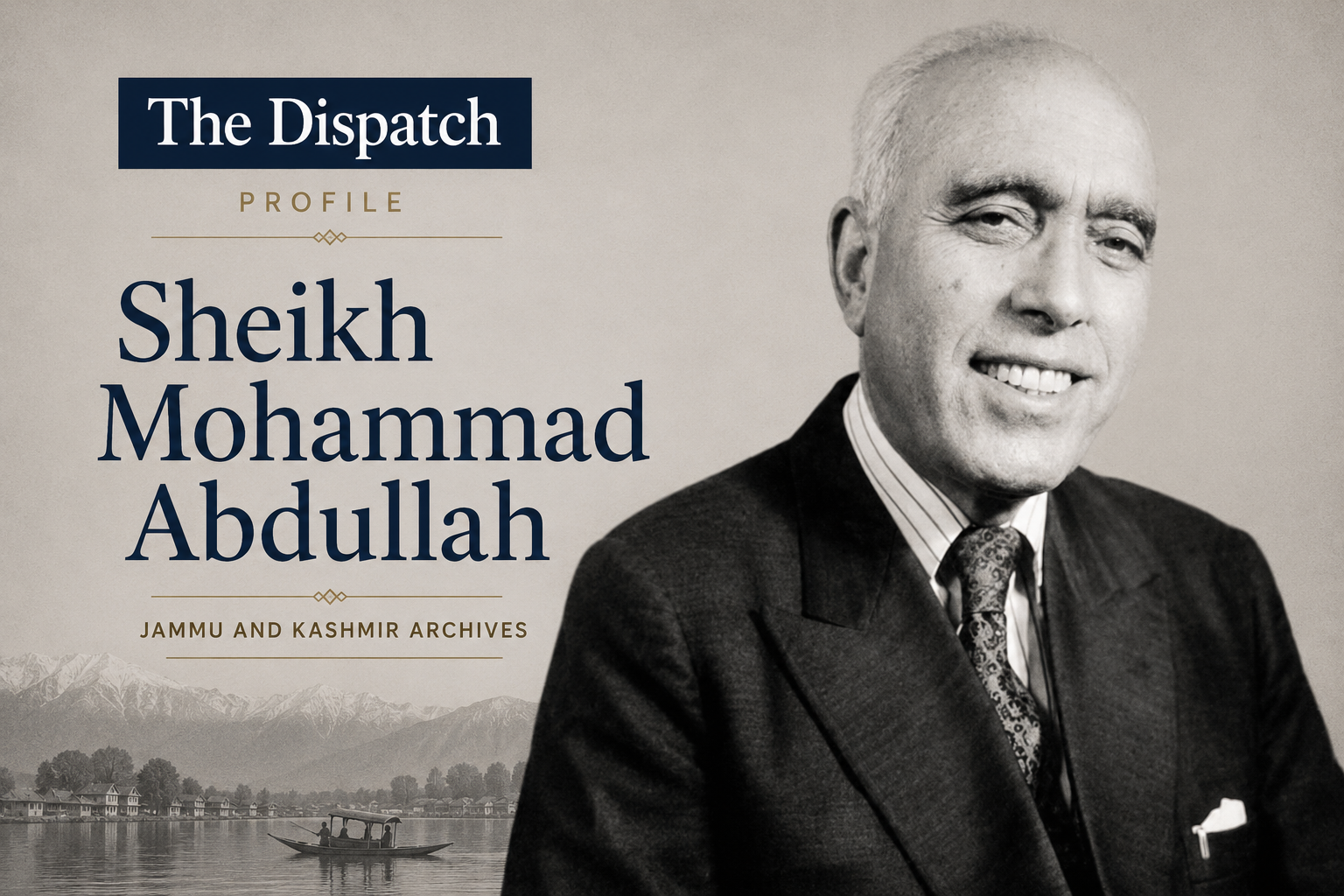
Mass Politics, Accession, and the Arc of Contradiction
Sheikh Mohammad Abdullah—widely known as the “Sher-e-Kashmir”—was the most consequential political figure to emerge from Jammu and Kashmir in the twentieth century. More than any other individual, he transformed politics in the state from princely authority to mass mobilisation, and in doing so, placed himself at the centre of every major political turn that followed.
Born on 5 December 1905 in Soura, Srinagar, Abdullah was educated at Aligarh Muslim University, where he studied science. He returned to Kashmir at a time of growing political unrest and quickly emerged as a compelling voice against monarchical rule. The agitation of 1931 marked his political arrival, and from that point onward, he became the principal figure of organised political assertion in the Valley.
Initially associated with the Muslim Conference, Abdullah recast the movement in 1939 into the National Conference, repositioning it as a secular, broad-based organisation. His “Naya Kashmir” programme articulated a forward-looking vision of democratic governance, land reform, and social justice—placing him at the forefront of a new political imagination in the state.
By the 1940s, Abdullah’s authority rested not on office, but on mass support. His alignment with Jawaharlal Nehru and the Indian National Congress shaped his ideological direction. He rejected the two-nation theory and articulated a political future for Jammu and Kashmir within a secular Indian framework.
That position acquired decisive importance in 1947. As the state faced invasion by tribal forces from Pakistan’s North-West Frontier Province, the question of accession moved from uncertainty to urgency. While the legal authority to accede rested with Hari Singh, Abdullah’s support provided the crucial element of political legitimacy. In effect, the accession carried both a legal and a popular dimension—and Abdullah was central to the latter.
Following accession, he assumed leadership of the interim government and later served as Prime Minister of Jammu and Kashmir. His early years in office were marked by sweeping land reforms, which fundamentally altered the socio-economic structure of the Valley and consolidated his mass base.
Yet, the relationship that had defined his rise soon became strained. Differences with New Delhi over autonomy and the future constitutional position of the state deepened. In 1953, Abdullah was dismissed from office and arrested—a moment that marked not just a personal fall, but a structural rupture in the state’s politics.
The decades that followed were marked by uncertainty and contestation. Abdullah remained a central political figure, but now as an oppositional force. His advocacy, at various points, for self-determination and a plebiscite sustained a powerful political sentiment within sections of Kashmir. At the same time, it deepened mistrust in New Delhi and complicated his standing within the Indian political establishment.
This phase continues to define one of the most debated aspects of his career. For many in Kashmir, it raised expectations of an alternative political resolution. For others, it introduced ambiguity into a relationship that had earlier appeared settled.
The turning point came in 1975, when Abdullah entered into an accord with Indira Gandhi and returned to power as Chief Minister within the framework of the Indian Constitution. The agreement closed one chapter of confrontation but opened another of interpretation. To his supporters, it represented pragmatism and a return to governance; to his critics, it fell short of the political aspirations he had once articulated.
Abdullah remained Chief Minister until his death on 8 September 1982. By then, his position had evolved from that of a mass agitator to a governing figure working within a defined constitutional arrangement.
His legacy is both foundational and contested. He is remembered as the architect of modern political consciousness in Kashmir, the leader who challenged princely rule, shaped democratic politics, and lent popular legitimacy to accession. At the same time, his shifting positions—between assertion, confrontation, and accommodation—have ensured that his role is interpreted in sharply different ways.
Sheikh Abdullah does not fit into a single narrative. He represents the arc of Jammu and Kashmir’s modern politics itself—where conviction met circumstance, where authority shifted, and where the question of identity and autonomy remained unresolved even as structures of governance took shape.
Leave a Reply