
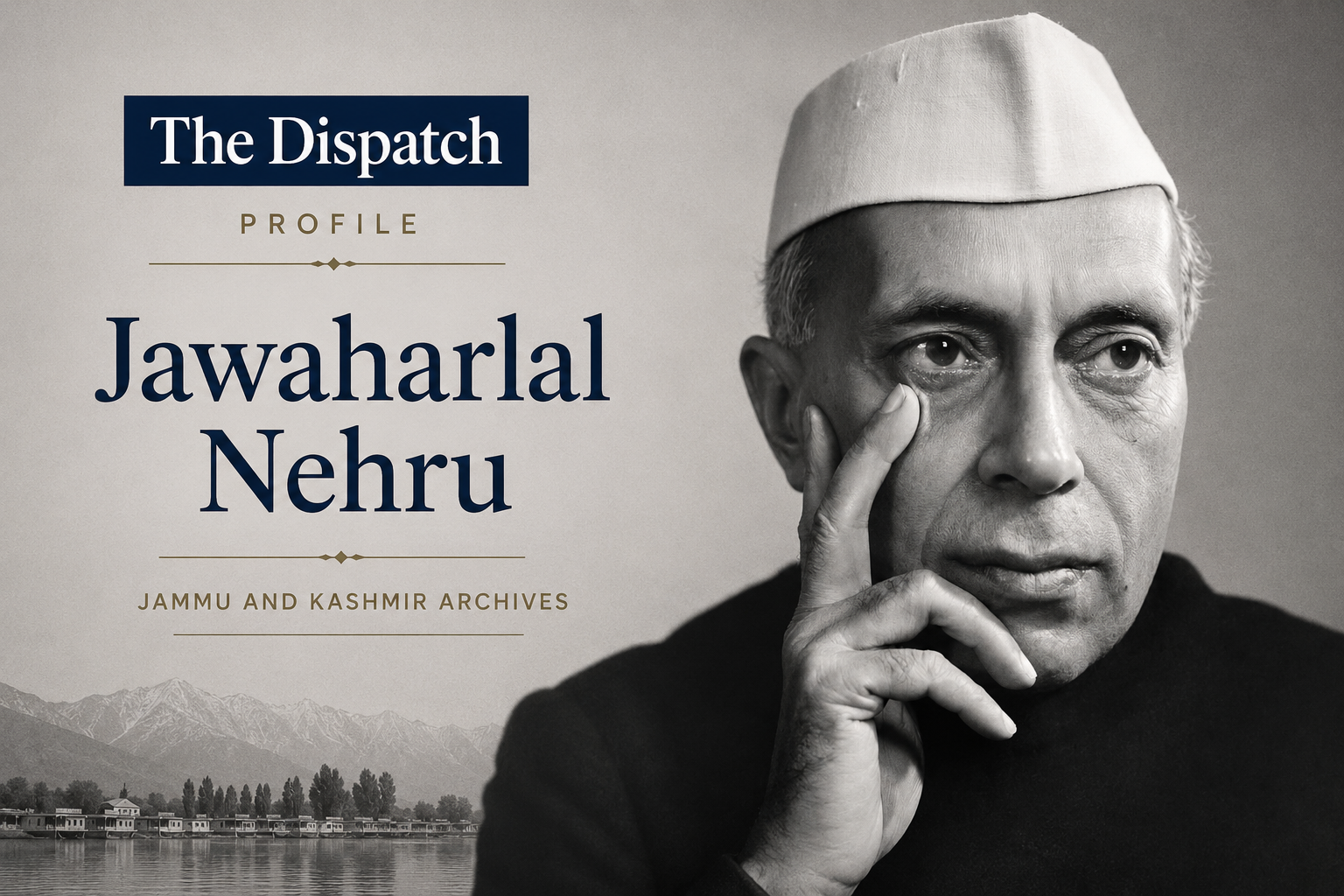
Idealism, Intervention, and the Kashmir Question
Prime Minister Jawaharlal Nehru was the central architect of India’s early policy on Jammu and Kashmir, shaping its political, constitutional, and international trajectory in the years following Independence. His engagement with the region combined personal attachment, ideological conviction, and the responsibilities of statecraft—often reinforcing each other, at times pulling in different directions.
Born on 14 November 1889 in Allahabad into a Kashmiri Pandit family, Nehru retained a strong emotional and cultural connection to Kashmir throughout his life. This personal dimension informed his political interest, though his decisions were ultimately driven by broader considerations of nation-building and international positioning.
His involvement in Kashmir predated 1947. By the mid-1930s, Nehru had emerged as a leading figure of the Indian freedom movement, while Sheikh Mohammad Abdullah was consolidating his position as the foremost mass leader in the Valley. The two developed a close political and personal relationship, grounded in a shared commitment to secular politics and opposition to communal divisions.
Nehru is widely understood to have encouraged Abdullah’s transformation of the Muslim Conference into the National Conference in 1939, broadening its ideological base and aligning it more closely with the Indian National Congress. This convergence would later prove decisive in shaping Kashmir’s political direction.
The Nehru–Abdullah relationship became a defining factor in the state’s politics, and a source of concern for Hari Singh. These tensions were evident during the Quit Kashmir movement of 1946, when Abdullah was arrested. Nehru attempted to enter the state to support him legally but was prevented from doing so—an episode that underscored both his personal commitment and the widening divide between monarchical authority and popular leadership.
In 1947, as Partition unfolded and Jammu and Kashmir came under attack from tribal forces backed from Pakistan, Nehru played a central role in India’s response. Following the signing of the Instrument of Accession, India intervened militarily to secure the Valley. Once the immediate crisis stabilised, Nehru shifted emphasis toward diplomacy. He referred the matter to the United Nations, engaged Pakistan through negotiations, and sought to build international support for India’s position.
This dual approach—military defence combined with international engagement—became a defining feature of India’s Kashmir policy. At the same time, Nehru relied on the National Conference to provide political legitimacy within the state, reinforcing Abdullah’s position as the primary internal partner of New Delhi.
However, this alignment did not endure. By the early 1950s, differences between Nehru and Abdullah sharpened over questions of autonomy and the pace of constitutional integration. These tensions culminated in August 1953, when Abdullah was dismissed and arrested. Contemporary accounts, including those of Intelligence Bureau chief B. N. Mullick, indicate that Nehru was directly involved in the decision and closely monitored its execution. The episode marked a decisive shift—from partnership to control—in New Delhi’s approach to Kashmir.
In the years that followed, Nehru supported the government of Bakshi Ghulam Mohammad, allowing the National Conference to continue as the principal political instrument rather than introducing the Congress directly into the state’s politics. This reflected a calibrated strategy aimed at maintaining continuity while advancing integration.
In his later years, Nehru showed signs of revisiting the Kashmir question through dialogue. The Kashmir Conspiracy Case against Abdullah was withdrawn, and steps were taken toward reconciliation. Abdullah was released and, in 1964, sent to Pakistan in an exploratory capacity to facilitate discussions. This initiative remained incomplete, as Nehru passed away on 27 May 1964.
Nehru’s role in Jammu and Kashmir remains foundational yet debated. He was instrumental in securing accession, shaping the state’s early political framework, and defining India’s diplomatic posture. At the same time, his decisions—particularly the internationalisation of the issue and the dismissal of Abdullah—have been interpreted in sharply different ways.
His engagement with Kashmir reflects a larger tension between idealism and control: between a vision of democratic legitimacy and the imperatives of managing a sensitive border state. That tension, once set in motion, has continued to influence the course of Jammu and Kashmir’s politics long after his time.
Leave a Reply