
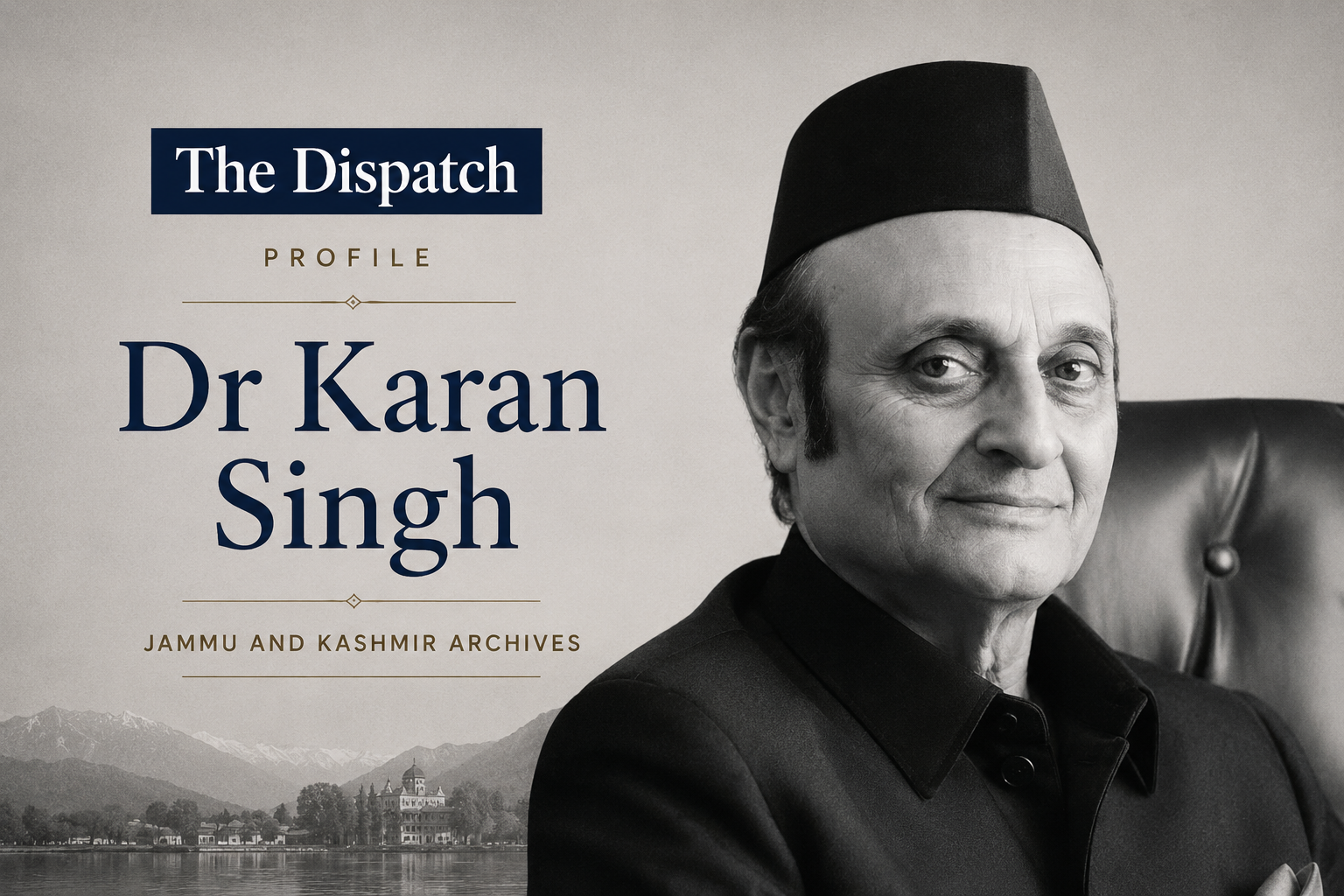
Between Throne and Constitution
Few figures in Jammu and Kashmir’s political history have occupied a position as unusual—or as enduring—as Karan Singh. He did not emerge from agitation, nor did he rise through electoral contest. Instead, he stood at the point where one political order ended and another began.
Born on 9 March 1931, the son of Hari Singh, Karan Singh inherited not power in the traditional sense, but responsibility at a moment when authority itself was being redefined. In 1949, at the age of nineteen, he was appointed Regent—effectively replacing his father as the constitutional head of the state in a transition shaped by political pressures within Kashmir and the evolving approach of New Delhi.
It was an extraordinary beginning. He entered public life not by gradual ascent, but by stepping directly into the centre of a complex and unsettled political landscape.
In the years that followed, his role was less about assertion and more about presiding over transition.
As Regent, and later as Sadr-e-Riyasat under the state’s special constitutional arrangement, Karan Singh occupied an office that sat between two worlds: the residue of princely sovereignty and the emerging framework of democratic governance. His tenure coincided with critical developments—the Delhi Agreement of 1952, the gradual extension of Indian constitutional provisions, and the steady redefinition of the state’s relationship with the Union.
He was not the author of these changes, but he was present at each step as they took shape.
The most consequential moment of his constitutional role came in August 1953.
As Sadr-e-Riyasat, he formally approved the dismissal of Sheikh Mohammad Abdullah and the installation of Bakshi Ghulam Mohammad. The decision has remained one of the most debated episodes in the region’s political history. Karan Singh later reflected that the events of that night brought him a sense of resolution—an observation that hints at both the burden of the decision and the clarity with which he viewed it.
What distinguishes his early public life is the manner in which it unfolded alongside his intellectual development.
Even while serving as the constitutional head, he continued his higher education and maintained an active engagement with scholarship. His correspondence from the period, including exchanges with Jawaharlal Nehru, reflects a young leader already comfortable navigating both political responsibility and intellectual inquiry.
This duality would remain a defining feature of his career.
Karan Singh continued as the constitutional head of Jammu and Kashmir—first as Regent, then as Sadr-e-Riyasat, and later as Governor—until 1967. The change in nomenclature in 1965, replacing Sadr-e-Riyasat with Governor, marked another step in aligning the state more closely with the Indian Union. Through these transitions, he remained a constant presence, lending continuity to a system that was itself evolving.
His move to national politics in 1967 opened a new phase. As a Union Minister and a senior figure in the Indian National Congress, he remained part of the central political establishment for decades. At the same time, his identity retained a regional dimension. For many in Jammu, he continued to represent a link to the Dogra legacy, even as the politics of the Valley followed its own trajectory.
Beyond formal politics, Karan Singh’s intellectual life has been equally significant. His writings on philosophy, religion, culture, and governance reflect a sustained engagement with India’s civilisational traditions. While long associated with the Congress, aspects of his thought have intersected with broader currents in Indian intellectual life, giving his work a reach that extends beyond partisan boundaries.
In later years, he remained engaged with the question of Jammu and Kashmir. He chaired the autonomy committee in 1996 under Farooq Abdullah and, more recently, expressed support for the abrogation of Article 370 while voicing reservations about the state’s downgrading to a Union Territory—positions that reflect a consistent preference for integration, tempered by institutional concern.
Karan Singh’s place in the history of Jammu and Kashmir lies not in dramatic assertion, but in continuity.
He was present at the transition from monarchy to constitutional order, at the redefinition of the state’s relationship with India, and at the gradual reshaping of its political structure. Few individuals have witnessed—and participated in—so many phases of that transformation.
He stands, in that sense, less as a political actor in the conventional mould and more as a bridge across eras—from throne to constitution, from inheritance to institution.
Leave a Reply