
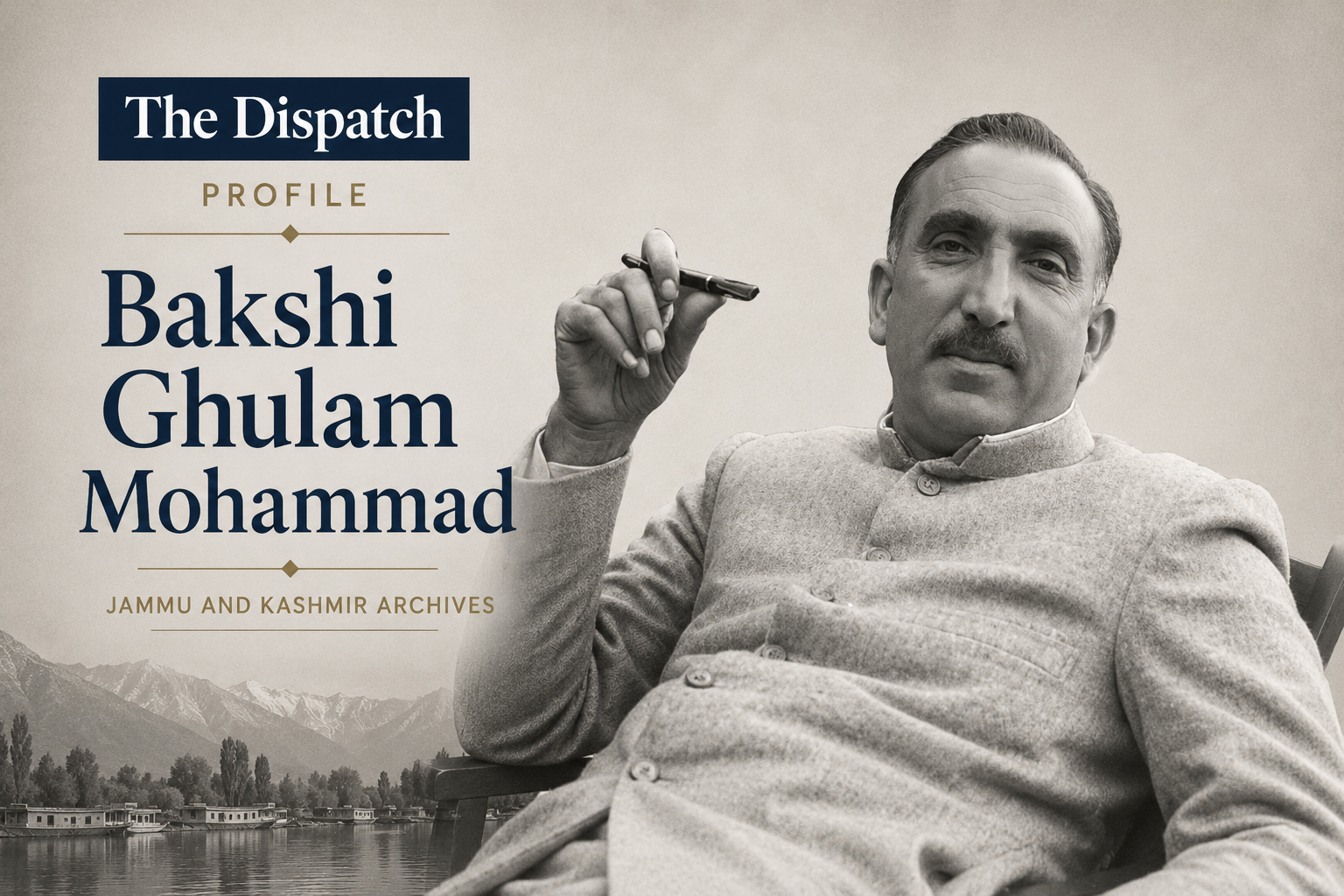
Delhi’s Trusted Partner in Kashmir
If Sheikh Mohammad Abdullah embodied the rise of mass politics in Jammu and Kashmir, Bakshi Ghulam Mohammad represents one of its most consequential reversals. Few figures illustrate as sharply the transition from political loyalty to political takeover, and from mass assertion to state-managed authority.
Bakshi’s early political life was defined by proximity to Sheikh Abdullah. He was not merely an associate but one of his closest aides, often expressing that loyalty to Sheikh was, for him, an article of faith. He was part of the National Conference in its formative years, when the movement challenged princely rule and mobilised popular support across the Valley. There was little to suggest that he would one day stand at the centre of its most decisive internal rupture.
That moment came in August 1953.
With Sheikh Abdullah dismissed and arrested, Bakshi assumed power—swiftly and decisively. The transition was not gradual, nor the result of a long ideological drift. It was immediate, and it altered the direction of politics in the state. From that point onward, Bakshi was no longer a functionary within a movement; he became the principal figure in a new political order.
His decade in office reoriented governance. The emphasis shifted from mobilisation to administration, from political negotiation to institutional consolidation. Roads were built, schools expanded, public services widened, and state-led welfare—particularly subsidised food and employment—reached large sections of the population. For many, this was the first sustained experience of the state as a provider.
But this transformation carried a deeper shift.
Bakshi worked in close alignment with New Delhi, and under his tenure, the process of Jammu and Kashmir’s integration with the Indian Union accelerated. Central institutions and constitutional provisions were extended gradually but steadily. This marked a clear departure from the framework of autonomy that Sheikh Abdullah had negotiated. What had earlier been a politically mediated relationship now moved toward a more administrative and institutional alignment.
This realignment came at a cost.
Bakshi’s authority rested on the removal of a leader with deep popular legitimacy, and that shadow never fully receded. Elections during his tenure were held, but were widely criticised for lacking genuine contest. Opposition space narrowed, and politics, for a period, shifted from mobilisation to management.
His governance style reinforced this shift. It was practical, results-oriented, and often patronage-driven. Access to state resources—jobs, welfare, opportunities—was frequently mediated through political networks. This created a system that secured loyalty through delivery, even as it attracted criticism for favouritism and uneven distribution.
By the early 1960s, the limits of this model became evident. Political pressure grew, and in 1963 Bakshi stepped down. His subsequent arrest during the tenure of Ghulam Mohammad Sadiq further complicated his image, marking a shift from authority to vulnerability.
Yet, he did not withdraw. In 1967, he entered Parliament and revived his own faction of the National Conference, re-emerging as an opposition figure within the state. This later phase reflected not only his resilience, but also the fluid nature of political alignments in Jammu and Kashmir.
Bakshi Ghulam Mohammad’s place in history lies in the transformation he embodied. He began as a loyalist within a mass movement and became the architect of a state-centred political order. He expanded governance and accelerated integration, but did so in a manner that narrowed democratic space and altered the balance between autonomy and control.
His career marks the point at which the politics of Jammu and Kashmir shifted—from movement to management, from negotiation to consolidation—a shift whose consequences continue to shape the region’s political structure.
Leave a Reply