
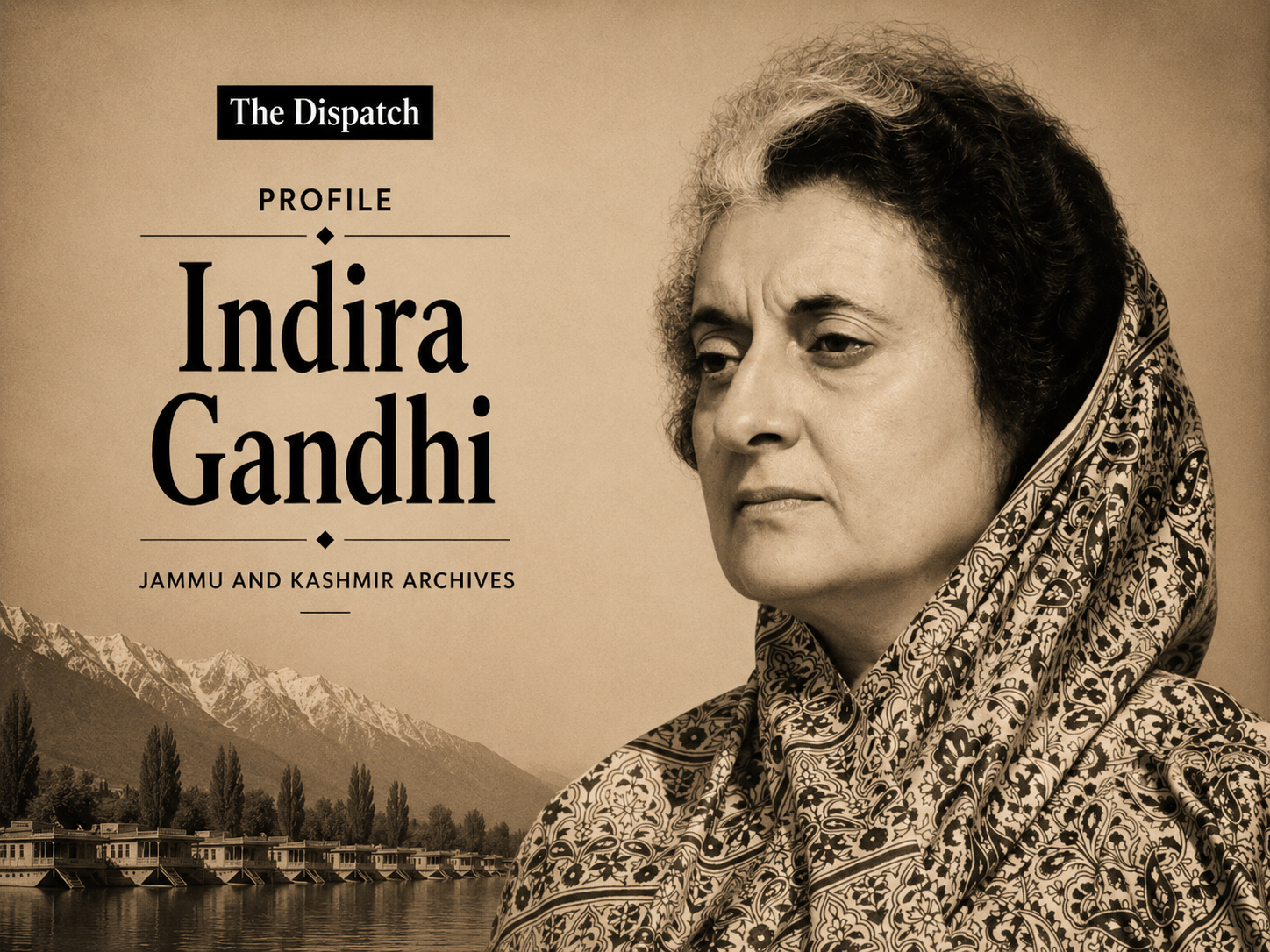
Central Authority, Kashmir Strategy, and the Politics of Control and Reconciliation
For much of the post-1960s history of Jammu and Kashmir, the decisive political axis ran not through Srinagar, but through New Delhi—and at its centre stood Indira Gandhi.
Her engagement with Kashmir was not incidental. Like her father, Jawaharlal Nehru, she carried a personal and emotional connection to the region, shaped by heritage and political inheritance. Early accounts suggest that in the 1950s—around the time of the state’s evolving constitutional framework—she even explored the possibility of acquiring land in Kashmir to build a house. That such a question arose at all was notable, given the legal restrictions on land ownership by non-state subjects. Consultations at the time, involving figures such as Karan Singh and the state government, indicate the sensitivity attached to such matters.
When Indira Gandhi assumed office as Prime Minister in the mid-1960s, Kashmir quickly became an area of focused attention. Her approach combined centralisation of authority with calibrated political engagement. She worked closely with leaders such as Ghulam Mohammed Sadiq and Syed Mir Qasim, under whose tenures the process of constitutional integration with the Union was advanced further.
At the same time, she kept open channels with Sheikh Mohammad Abdullah, recognising that durable political stability required engagement with popular leadership in the Valley. This dual track—control and outreach—defined much of her Kashmir policy.
Her inner circle included several influential figures of Kashmiri origin, such as D. P. Dhar, P. N. Haksar, and Makhan Lal Fotedar, among others. During her tenure, sections of the Kashmiri Pandit community occupied prominent positions within the political and administrative structure at the national level—an aspect that shaped both policy inputs and perceptions.
The 1971 war with Pakistan, culminating in India’s decisive victory, and the subsequent Shimla Agreement of 1972, altered the external framework of the Kashmir question. By converting the ceasefire line into the Line of Control and emphasising bilateralism, the agreement reshaped how the dispute was approached internationally.
Indira Gandhi’s most consequential political intervention within the state came in 1975, when she facilitated the return of Sheikh Abdullah to power through the Indira–Sheikh Accord. This required the resignation of Syed Mir Qasim, a move that underscored her willingness to reconfigure existing arrangements in pursuit of broader political consolidation. The accord marked a shift—from prolonged confrontation to conditional accommodation.
Her relationship with Sheikh’s successor, Farooq Abdullah, was markedly different. Accounts from the period suggest a lack of trust, and her style of governance—often described as decisive and unwilling to accommodate dissent—shaped the course of events. In 1984, the elected government led by Farooq Abdullah was dismissed and replaced through political realignment, an episode widely seen as having the imprint of New Delhi’s intervention.
Indira Gandhi’s engagement with Kashmir continued until the very end of her life. She was in Srinagar just days before her assassination in October 1984, reflecting the continued centrality of the region in her political thinking.
Her legacy in Jammu and Kashmir does not settle easily into a single frame. It reflects a combination of: assertion of central authority; strategic accommodation of regional leadership and direct intervention in moments of political uncertainty
The structures she shaped—and the precedents she set—continued to influence the trajectory of the state long after her tenure.
Further Reading
- Indira Gandhi: A Biography
- Kashmir in Conflict
- My Life, My Times
- Archival records on the Shimla Agreement (1972)
- Studies on the Indira–Sheikh Accord (1975)
Leave a Reply