
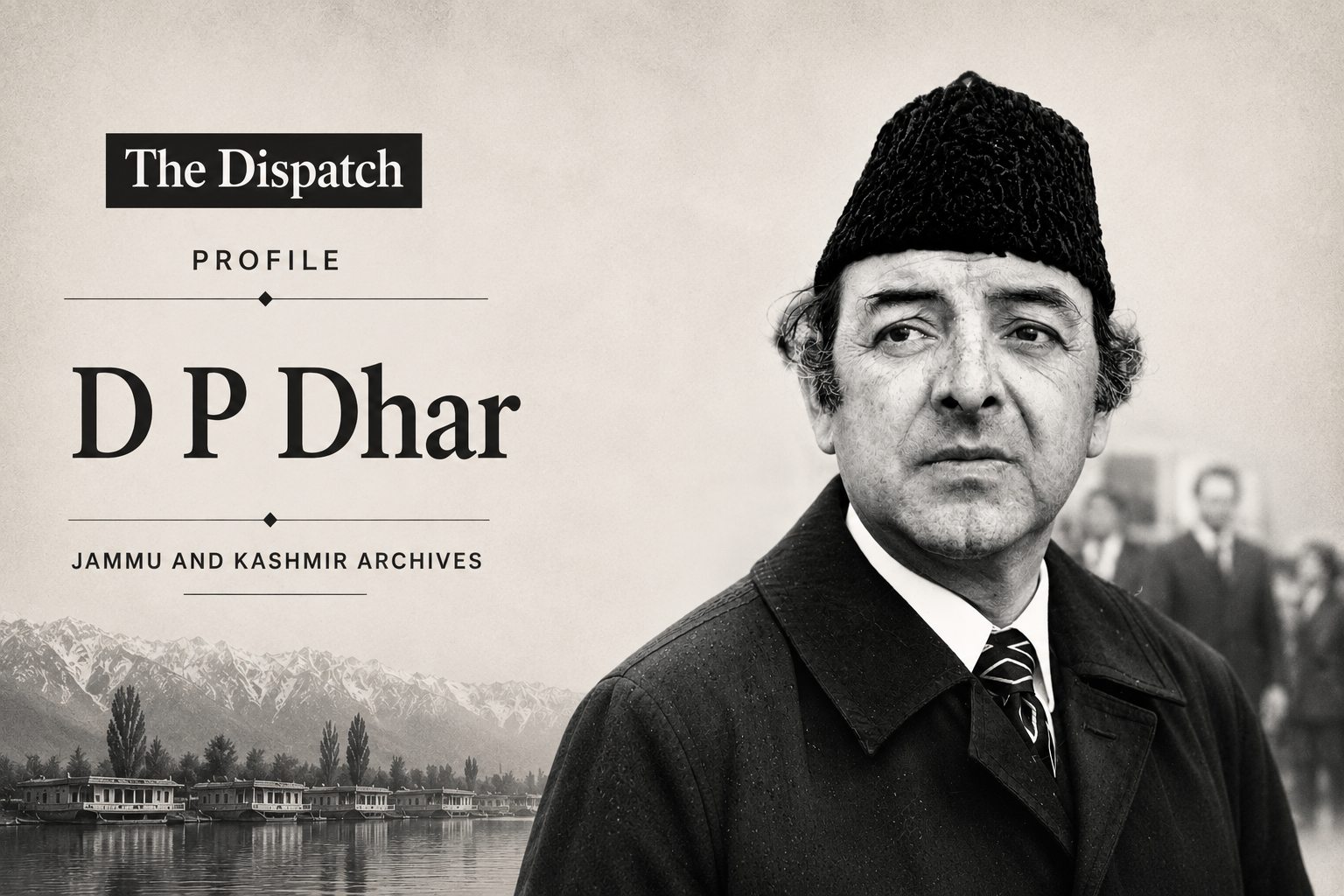
Strategist, Diplomat, and Architect of India’s Kashmir and Foreign Policy Interface
Durga Prasad Dhar, born in 1918 in Srinagar, was one of the most influential Kashmiri figures to operate at the intersection of state politics, national strategy, and international diplomacy in post-Independence India. Unlike many of his contemporaries in Jammu and Kashmir, Dhar’s significance lay not in mass leadership but in his role as a political strategist and policy architect.
Educated in Srinagar and Lahore, Dhar entered public life through his association with the National Conference and its leadership under Sheikh Mohammad Abdullah. In the early years, he was part of the broader intellectual and political circle that included leaders such as G. M. Sadiq and Girdhari Lal Dogra—figures often identified with progressive and, at times, explicitly left-leaning ideological orientations. Dhar’s own outlook reflected a similar inclination toward state-led development and structural reform.
Following the political changes of 1953, Dhar remained engaged in the evolving political framework of Jammu and Kashmir. However, his trajectory increasingly moved beyond the confines of state politics. His administrative acumen, political understanding, and strategic thinking brought him into closer engagement with the leadership in New Delhi.
Dhar’s rise at the national level was closely linked to his association with Indira Gandhi, under whom he became one of the most trusted advisers on matters relating to Jammu and Kashmir and foreign policy. His role expanded significantly during the late 1960s and early 1970s, a period marked by major geopolitical shifts in South Asia.
He served as India’s Ambassador to the Soviet Union, a position of considerable importance at a time when India was strengthening its strategic partnership with Moscow. Dhar played a key role in consolidating Indo-Soviet relations, which proved crucial during the 1971 Bangladesh crisis. His diplomatic efforts are widely regarded as having contributed to securing Soviet support for India at a critical juncture, including through the Indo-Soviet Treaty of Peace, Friendship and Cooperation.
Beyond formal diplomacy, Dhar functioned as a backchannel strategist, often involved in sensitive negotiations and policy formulation. His understanding of both Kashmir’s internal dynamics and India’s external strategic environment made him a valuable interlocutor between different spheres of decision-making.
Dhar also played an important role in shaping the political approach toward Jammu and Kashmir during the period leading up to the 1975 accord between the Government of India and Sheikh Abdullah. While not always visible in public narratives, his contribution to creating conditions for political reconciliation is widely acknowledged in policy circles.
Unlike mass leaders who relied on public mobilisation, Dhar’s influence was exercised through proximity to power, intellectual input, and strategic counsel. He represented a class of political actors whose impact is often indirect but deeply consequential.
D. P. Dhar died in 1975, the same year that marked a turning point in Jammu and Kashmir’s political trajectory with the return of Sheikh Abdullah to power.
His legacy lies in his role as a bridge between Kashmir and New Delhi, and between domestic politics and international strategy. He remains one of the few leaders from Jammu and Kashmir to have shaped not only the state’s political direction but also India’s foreign policy at a critical moment in its history.
Further Reading
- India’s Foreign Policy: Selected Speeches of D. P. Dhar — Insight into Dhar’s strategic thinking and diplomatic approach.
- The Blood Telegram by Gary J. Bass — Context on the 1971 crisis and India’s diplomatic positioning.
Leave a Reply