
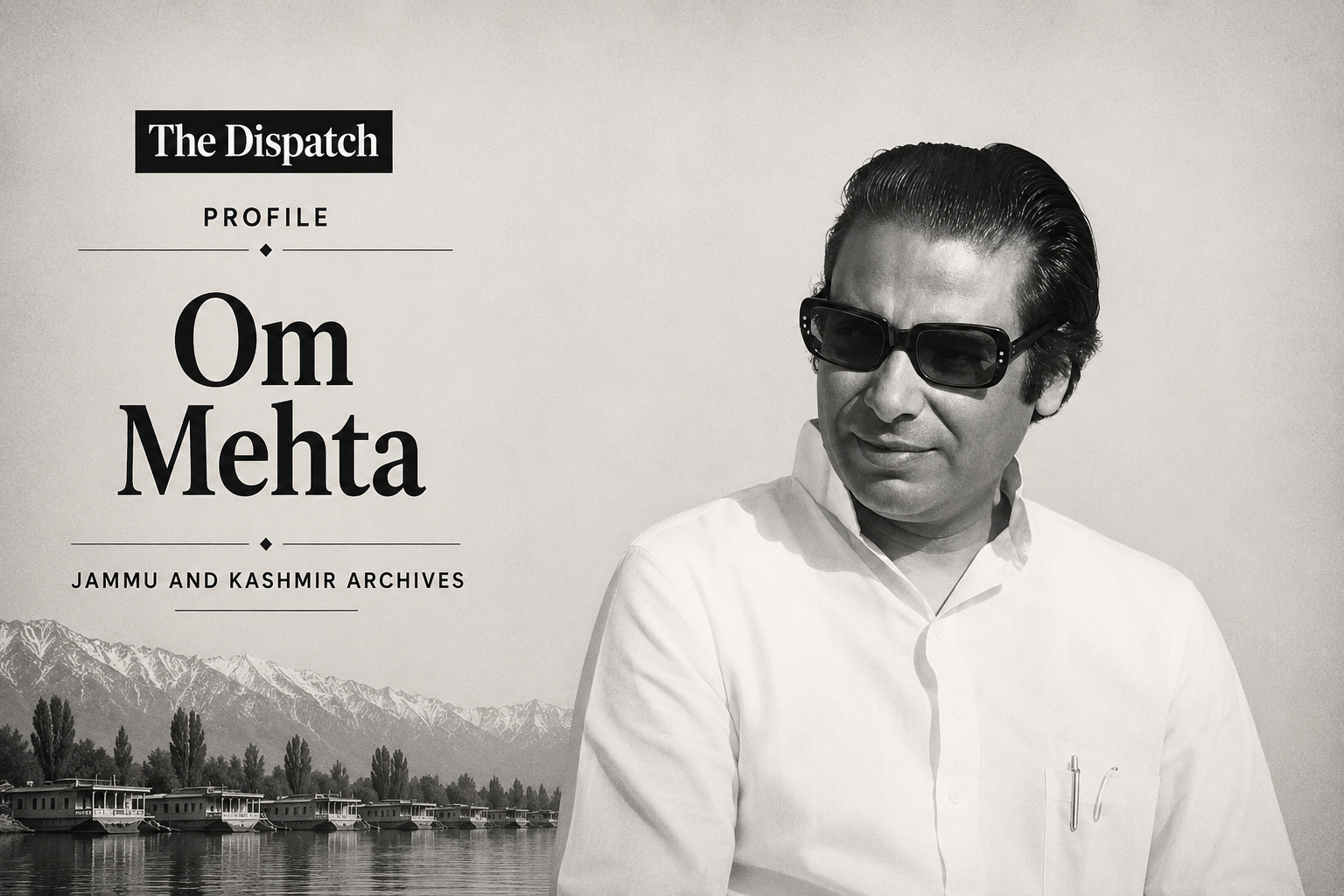
Congress Leader, Indira Gandhi Loyalist, and Key Link Between Jammu and New Delhi
Om Mehta (20 February 1927 – 12 February 1995) was an influential political figure from Jammu and Kashmir who rose within the Congress system to become a trusted associate of Indira Gandhi during a critical phase in India’s political history. Known for his organisational ability and proximity to the central leadership, he played a significant role in shaping the Centre–State interface in Jammu and Kashmir during the 1960s and 1970s.
Mehta hailed from the distinguished family of Mehta Basti Ram of Kishtwar, who had served as a key aide to the Dogra general Zorawar Singh and as Governor of Ladakh in the nineteenth century. This lineage reflected a longstanding association of the family with administration and statecraft in the region.
He was also closely related to Krishna Mehta, whose husband Mehta Duni Chand, then Deputy Commissioner of Muzaffarabad, was killed during the tribal invasion of 1947. Krishna Mehta later emerged as a prominent public figure and became the first woman Member of Parliament from Jammu and Kashmir in the Rajya Sabha.
Om Mehta entered public life at a relatively young age and was elected as a Member of the Legislative Council in 1957, marking the beginning of a long political career. He was initially associated with the National Conference before moving to the Congress in 1964, reflecting the broader political realignment of that period.
He soon moved to national politics and became a member of Parliament, serving in the Rajya Sabha and holding multiple responsibilities within parliamentary committees. Over time, he emerged as a key figure in Indira Gandhi’s inner circle.
A notable feature of his career was that he held important legislative and ministerial positions at both the state and national levels for nearly three decades without contesting a direct popular election. This unusual trajectory has often been viewed in the context of New Delhi’s effort to maintain a political balance—particularly ensuring representation and reassurance for the Dogra population of Jammu while managing the more complex political environment in the Kashmir Valley.
Mehta held several important portfolios in the Union government, including Minister of State for Shipping and Transport, Works and Housing, Parliamentary Affairs, and Home Affairs. His tenure as Minister of State for Home Affairs (1974–1977) placed him at the centre of internal security administration during the period of the Emergency.
During the Emergency (1975–1977), he was considered part of the core decision-making circle around Indira Gandhi and was closely associated with the functioning of the Home Ministry. He was also known to be close to Sanjay Gandhi, whose influence during this period shaped key administrative decisions.
Beyond his role in Delhi, Mehta retained a strong connection to his home region. He is credited with advocating developmental initiatives in the Kishtwar region, including improvements in road connectivity, infrastructure, and early push towards major hydroelectric projects such as the Dul Hasti project, as well as road linkages connecting Kishtwar to neighbouring regions.
Despite operating largely within the central political system, he remained an important link between Jammu and Kashmir and New Delhi, representing regional concerns within national decision-making structures.
Om Mehta passed away in 1995 in New Delhi.
His legacy is closely tied to the Congress system of governance in Jammu and Kashmir and to the centralisation of political authority during the Indira Gandhi era. He represents a category of leadership that functioned not through mass mobilisation, but through institutional access, administrative influence, and proximity to power, shaping outcomes from within the system.
Further Reading
- The Emergency: A Personal History
- Indira Gandhi: A Biography
- Parliamentary debates and records (1960s–1970s)
- Political profiles and archives of Kishtwar region (mykishtwar.com)
Leave a Reply