
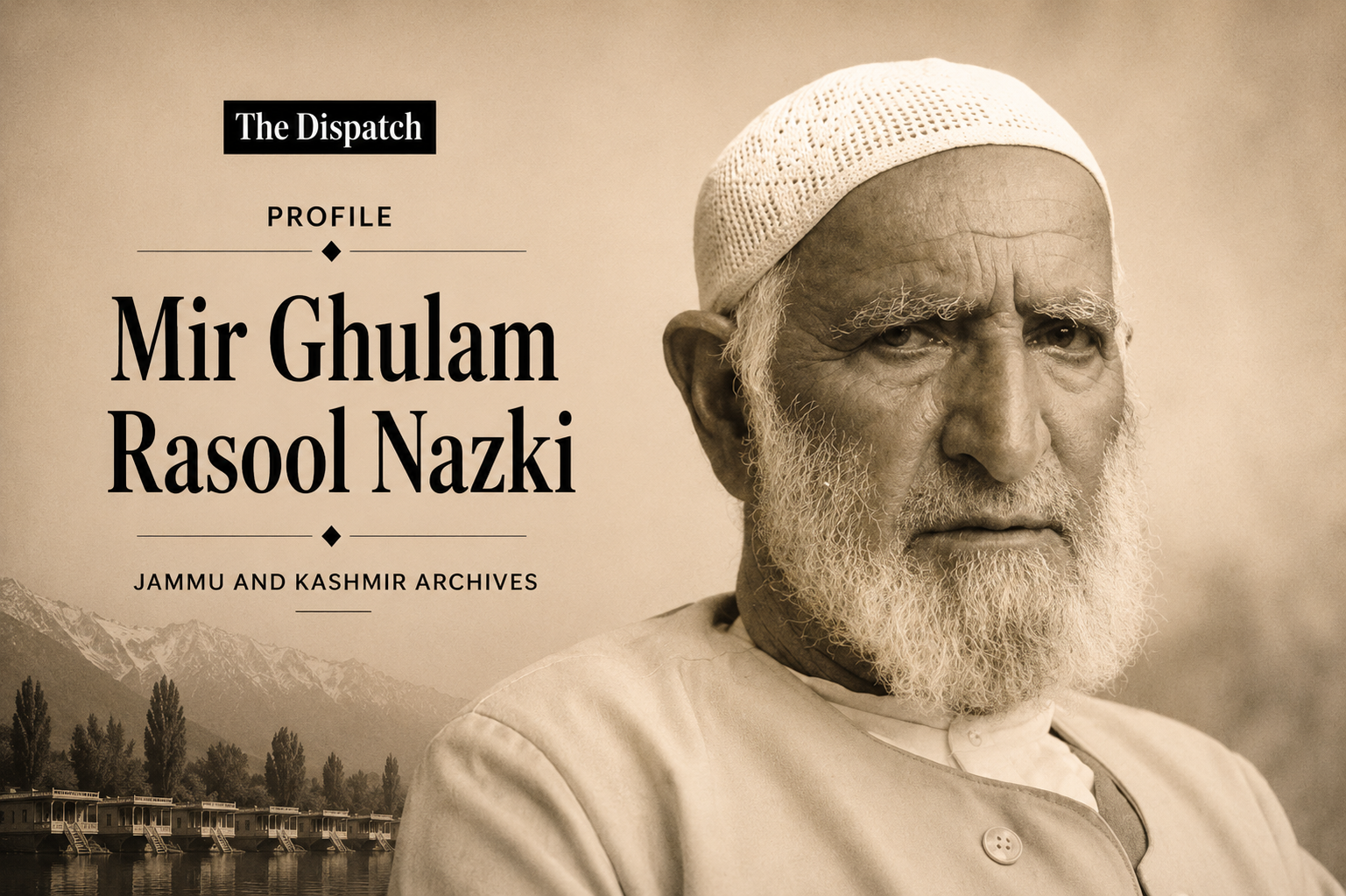
Poet, Broadcaster, and a Cultural Voice Across Generations
For many in Kashmir, literature was not encountered on the page first—it arrived through sound. In that space, voices like Mir Ghulam Rasool Nazki became familiar long before they were formally recognised.
Born in 1910, Nazki belonged to a generation that witnessed both the late princely period and the early decades after 1947. His life and work unfolded alongside the emergence of modern institutions in the region, particularly in language, culture, and communication.
He wrote poetry and prose, but his wider influence came through his association with Radio Kashmir, where he worked as a broadcaster and scriptwriter. At a time when radio was the most effective medium of public communication, this role placed him in direct contact with everyday life. Literature, in his case, was not confined to books—it was spoken, heard, and shared.
His writing carried a sense of restraint. It avoided excess and remained rooted in observation, often reflecting the rhythms of ordinary life and the gradual shifts within society. He did not present himself as a political voice, yet his work registered the environment around him without turning it into overt commentary.
Nazki was also part of a broader effort to shape Kashmiri as a modern expressive language. Through broadcasting, scripting, and literary engagement, he contributed to a phase when language was adapting to new forms—formal, public, and institutional.
What distinguishes him further is the continuity that followed. His influence did not remain limited to his own work. It extended into a family that, over time, became deeply embedded in literature, media, and public life.
His son, Farooq Nazki, emerged as a noted poet and a prominent voice in broadcasting. Another son, Ayaz Rasool Nazki, became a writer, scholar, and cultural administrator. Bilal Nazki went on to serve in the judiciary, including as Chief Justice of a High Court. Across fields, the family carried forward a sustained engagement with language, culture, and institutions.
Nazki himself did not foreground legacy. His work remained grounded in its own time and medium.
He passed away in 1998.
By then, the medium that had carried his voice—radio—was already beginning to yield space to newer forms. But for those who heard it in its time, it had already done its work.
Further Reading
- Collections of poetry and writings by Mir Ghulam Rasool Nazki
- Archives of Radio Kashmir (broadcast scripts and cultural programming)
- Studies on Kashmiri language development in the mid-20th century
- Works and writings of Farooq Nazki and Ayaz Rasool Nazki
Leave a Reply