
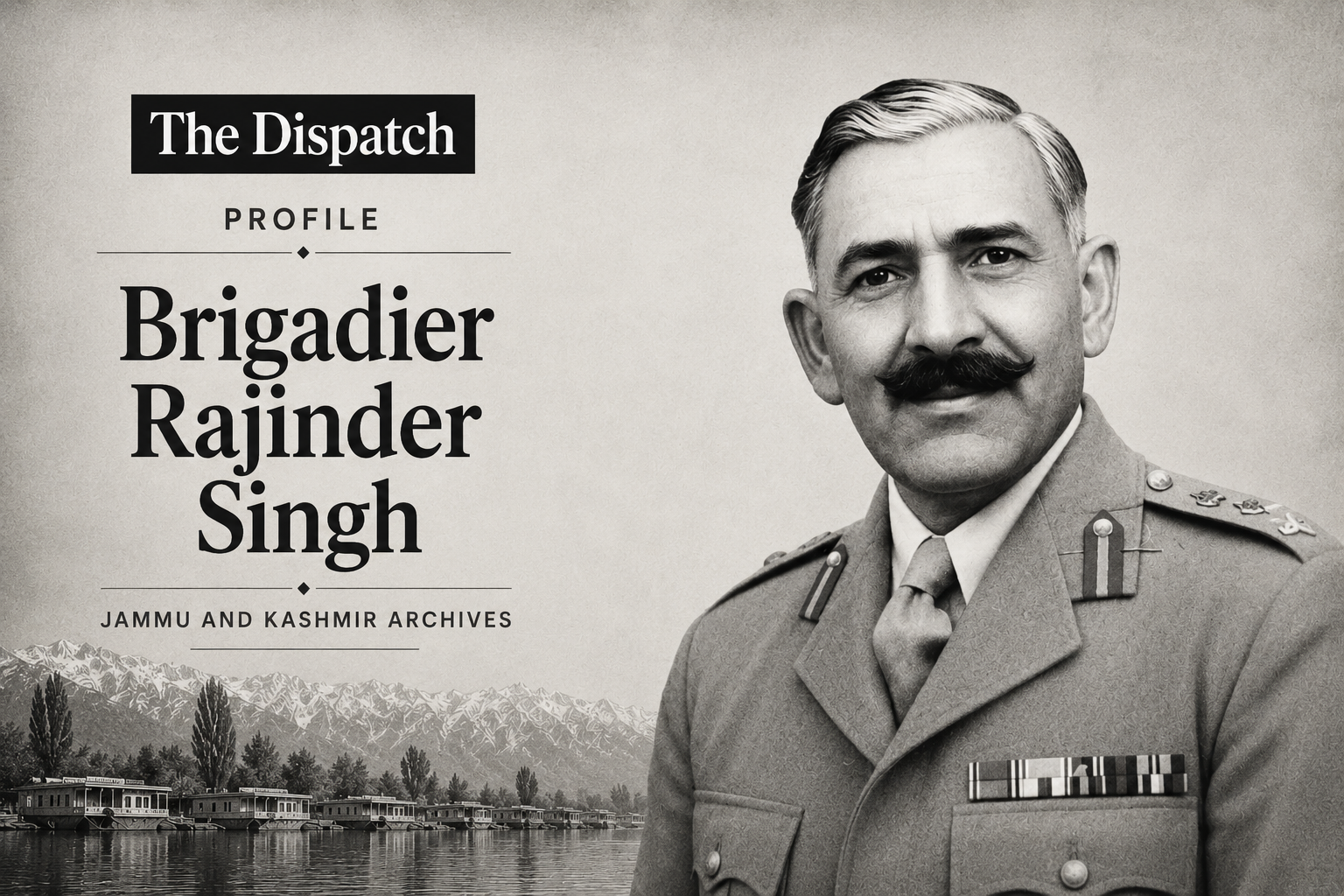
Defender of Kashmir and the Officer Who Delayed the Fall of Srinagar
Brigadier Rajendra Singh (14 June 1899 – 26 October 1947), often remembered as the first recipient of the Maha Vir Chakra, was the Chief of Military Staff of the princely state of Jammu and Kashmir at the time of the tribal invasion in October 1947. His actions in the opening days of the conflict played a decisive role in delaying the advance of invading forces towards Srinagar.
Born in Bagoona village in the Jammu region, Rajendra Singh joined the state forces at a young age and rose through the ranks on account of his discipline and professional competence. By 1947, he had become the senior-most military officer in the Jammu and Kashmir State Forces under Maharaja Hari Singh.
The crisis unfolded on 22 October 1947, when tribal raiders from Pakistan’s North-West Frontier, supported by elements from across the border, entered the territory of Jammu and Kashmir. The rapid advance of these forces posed an immediate threat to key towns and, ultimately, to Srinagar.
At this critical juncture, Rajendra Singh was ordered by Maharaja Hari Singh to “hold on till the last man and the last round.” With limited troops and resources at his disposal, he moved towards Uri and Baramulla to delay the advancing forces.
Over the next several days, Brigadier Rajendra Singh and his small contingent carried out a series of tactical withdrawals and demolitions, including the destruction of bridges along the route. These actions were aimed at slowing the enemy’s advance rather than engaging in direct confrontation, given the disparity in numbers.
The most significant of these efforts was the demolition of the bridge at Uri, which disrupted the momentum of the advancing raiders and bought crucial time. Despite being heavily outnumbered and under continuous attack, Rajendra Singh and his men continued to resist.
He was eventually killed in action near Uri on 26 October 1947, after sustaining injuries during the fighting.
The delay caused by his actions is widely regarded as having provided the critical window during which Maharaja Hari Singh signed the Instrument of Accession to India and Indian troops were airlifted into Srinagar on 27 October 1947.
For his bravery and leadership, Brigadier Rajendra Singh was posthumously awarded the Maha Vir Chakra, becoming its first recipient.
His legacy occupies a foundational place in the military history of Jammu and Kashmir. Unlike many later developments shaped by political processes, his role belongs to the immediate, decisive phase of conflict where time, terrain, and tactical judgment determined outcomes.
Further Reading
- Official Indian Army accounts of the 1947–48 operations in Jammu and Kashmir
- Studies on the tribal invasion of October 1947
- Military histories documenting early operations in Uri–Baramulla sector
Leave a Reply