
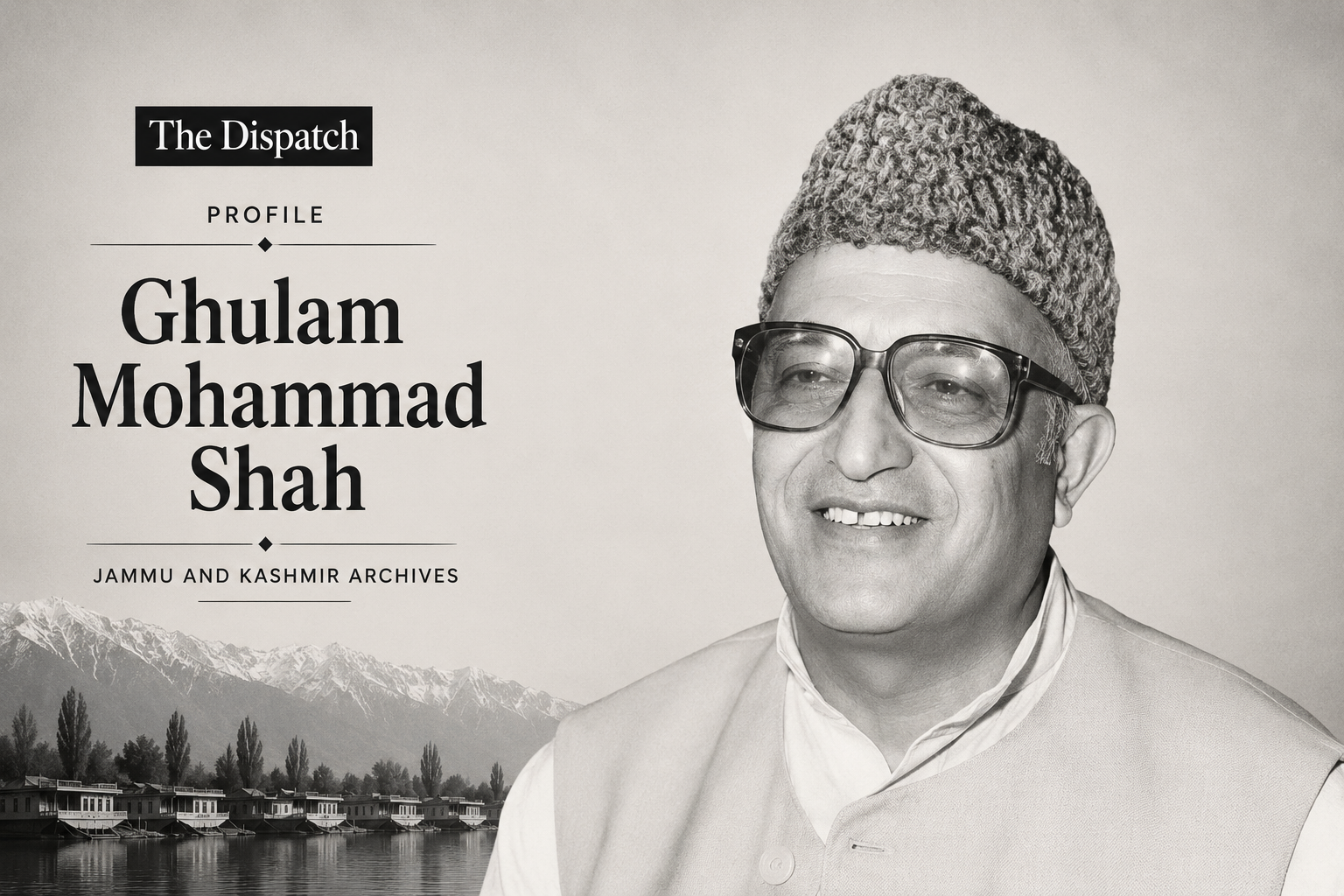
Contender to a Legacy and the Politics of Defection
In the years following Sheikh Mohammad Abdullah’s dominance of Jammu and Kashmir politics, the question of succession did not surface publicly—but it existed. Few felt it more keenly than Ghulam Mohammad Shah.
Born in 1920, Shah was not an outsider to the National Conference. He had been part of its inner circle since the 1940s, long before mass politics in the Valley took its later shape. Educated at the London School of Economics, he combined academic exposure with organisational work on the ground.
He was closely associated with Sheikh Abdullah through the most turbulent decades—the dismissal and arrest of 1953, the prolonged political uncertainty that followed, and the gradual return to power in 1975. During this period, Shah functioned as an organiser and strategist, not a public face.
His personal life further deepened this association. He married Sheikh Abdullah’s daughter, placing him within the family as well as the political structure.
Over time, this proximity shaped expectation. Shah came to see himself as a natural political heir—someone who had shared the struggle, understood the organisation, and remained consistently aligned during difficult years.
But succession in the National Conference did not follow that path.
In the final phase of Sheikh Abdullah’s life, the balance shifted towards his son, Farooq Abdullah. Though accounts suggest that alternatives were not entirely ruled out, Farooq was eventually elevated as party president during Sheikh’s lifetime, and the transition took on a familial and political inevitability.
For Shah, this was a turning point.
Tensions that had remained contained began to surface. Even before Sheikh’s death in 1982, there were indications of quiet efforts to consolidate support within the party. After Farooq assumed leadership, these differences sharpened into open rivalry.
The decisive moment came in 1984, when Shah engineered a defection within the National Conference, splitting the party and forming a government with the support of the Congress. The episode reflected not only personal ambition, but also the broader political climate shaped by New Delhi under Indira Gandhi, where alignments could be reconfigured from outside the state.
Shah initially claimed his faction to be the “real” National Conference. Later, he formalised his position by naming his party National Conference (Khalida)—after his wife, Khalida Shah.
His tenure as Chief Minister, however, was brief and marked by instability. The government struggled to establish legitimacy and cohesion, and in 1986 it was dismissed, bringing his period in power to an end.
After this, Shah’s political trajectory declined. His party—eventually reconstituted as the Awami National Conference—failed to regain significant ground. In later elections, including 2008, it fielded candidates widely but without meaningful electoral success. Leadership of the party passed to his family, including his son Muzaffar Shah, but its influence remained limited.
Shah passed away in 2009.
His political career does not fit easily into conventional categories. He was neither an outsider nor a mass challenger. He was, instead, a figure shaped by proximity—to leadership, to power, and to expectation. When succession took a different course, he chose rupture over accommodation.
The consequences of that choice extended beyond his own career.
Further Reading
- Accounts of the 1984 political crisis in Jammu and Kashmir
- Studies on succession politics within the National Conference
- Oral histories and interviews with NC leaders from the 1980s
- Analyses of Centre–State relations during the Indira Gandhi period
Leave a Reply