
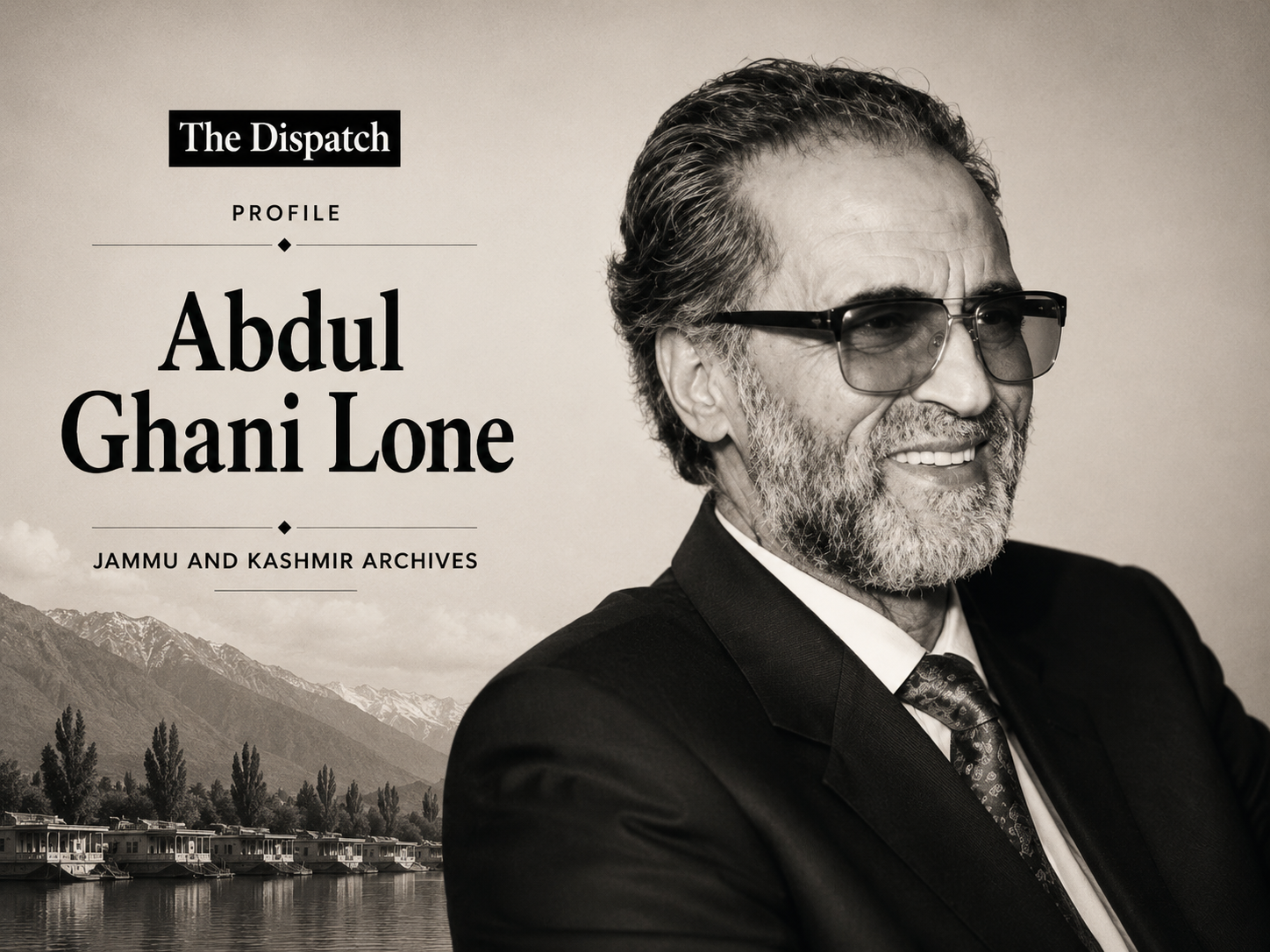
From Mainstream Politics to Moderate Separatism
The political journey of Abdul Ghani Lone does not follow the sharper breaks seen in figures like Syed Ali Shah Geelani. Instead, it reflects a gradual transition—one that began within the structures of electoral politics and moved, over time, toward a separatist position shaped by experience, disillusionment, and changing ground realities.
Born in 1932 in Handwara in north Kashmir, Lone entered politics through the mainstream framework and was associated with the Congress in his early career. He was not positioned as an ideologue at the outset, but as a political actor working within the existing system, building his base in a region that would later become central to his influence.
Through the 1970s and 1980s, Lone remained engaged in electoral politics, serving as a legislator and participating in governance structures. His politics during this period reflected the possibilities and limitations of mainstream engagement in Jammu and Kashmir—where representation existed, but was often contested in terms of credibility and autonomy.
The turning point, as with many others of his generation, came around the late 1980s. The eruption of militancy, combined with growing distrust of electoral processes, altered the political landscape fundamentally. Lone, like several contemporaries, moved away from the mainstream and became part of the All Parties Hurriyat Conference, formed in the early 1990s as a collective platform articulating separatist aspirations.
Within the Hurriyat, however, Lone occupied a distinct position. He was neither aligned with the hardline rigidity of Geelani nor entirely removed from the practicalities of politics. His approach leaned toward engagement and dialogue, recognising both the limits of confrontation and the need for a political process that could deliver outcomes.
This positioning brought him closer, in orientation, to figures like Mirwaiz Umar Farooq, even as internal differences within the Hurriyat remained significant. Lone was among those who believed that the path forward required negotiation rather than perpetual escalation.
His stance, however, also placed him in a difficult position. In an environment increasingly polarised between hardline separatism and state authority, moderation often carried its own risks. Voices advocating dialogue were vulnerable—not only politically, but physically.
In 2002, Abdul Ghani Lone was assassinated in Srinagar during a public event. His killing was widely seen as a blow to the moderate strand within separatist politics—removing a figure who, despite his separatist position, had shown willingness to engage and explore political pathways.
His legacy is therefore distinct. Unlike Geelani, who came to represent ideological certainty, Lone represented possibility within constraint—the idea that even within separatist politics, there could exist a space for dialogue and recalibration.
That space proved difficult to sustain.
Leave a Reply