
From Religious Mobilisation to Ideological Absolutism
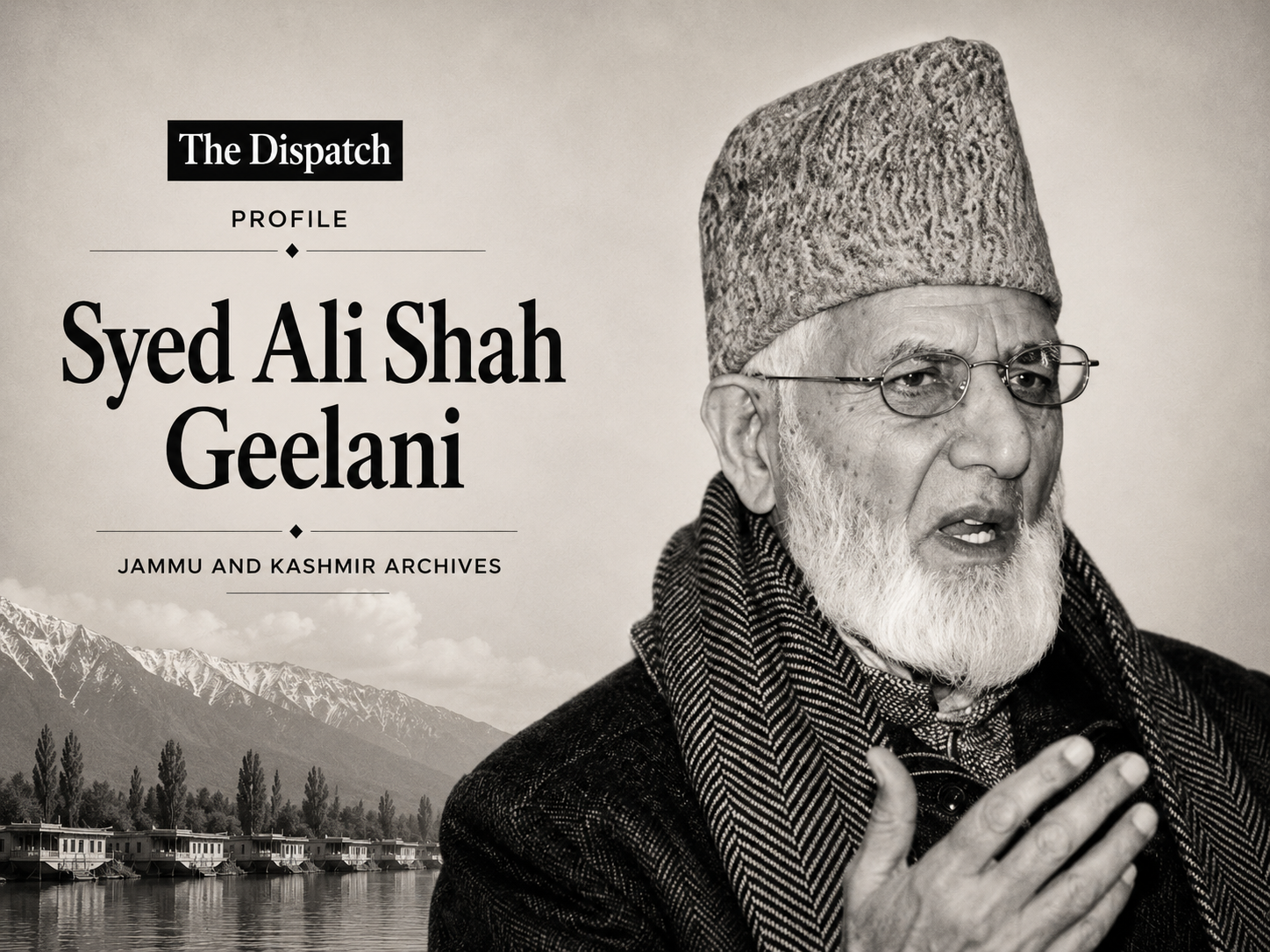
Few figures in Kashmir’s modern political history travelled as far—from participation within the system to a position of uncompromising rejection—as Syed Ali Shah Geelani. His trajectory was not abrupt; it was shaped by a specific political environment in which religion and politics began to intersect more visibly.
That environment took form in the 1960s. After the breakdown of his compact with New Delhi and repeated incarcerations, Sheikh Mohammad Abdullah increasingly turned to religious idioms and platforms to sustain political relevance and mobilisation. The Hazratbal shrine became a focal point for such outreach, and speeches during this phase carried a distinctly religious tone alongside political messaging. This did not replace Sheikh’s earlier mass politics, but it introduced a religio-political vocabulary into public discourse in a more sustained manner.
It was within this evolving space that Geelani emerged.
Already associated with Jamaat-e-Islami and grounded in a religious worldview, he did not enter politics as an outsider to this idiom but as someone who systematised and deepened it. Where Sheikh’s use of religion was situational and politically adaptive, Geelani’s approach was more doctrinal. He brought to the political field a structured ideological framework, rooted in religion and organisation, and positioned himself as a challenger to Sheikh’s authority—particularly among sections that were receptive to a more explicitly religious articulation of politics.
Yet, importantly, Geelani’s early political career remained within the electoral system. Through the 1970s and 1980s, he was an active participant in mainstream politics, winning elections as a Jamaat-backed candidate. He was not a marginal or fringe figure; he was part of the institutional process even while representing a distinct ideological current within it.
The decisive rupture came around 1989, when militancy transformed the political landscape. The framework within which Geelani had operated lost relevance in his assessment, and he moved away from electoral politics toward a position that rejected engagement with the Indian state.
Over time, this position hardened into a clear doctrine. He advocated Kashmir’s accession to Pakistan and insisted that any resolution must be based on recognition of Kashmir as a tripartite dispute involving India, Pakistan, and the people of the region. This stance was not negotiable. It defined his politics—and also defined its limits.
Within the separatist spectrum, Geelani came to represent the hardline position, often in contrast with leaders such as Mirwaiz Umar Farooq, who were more open to dialogue. These differences reflected fundamentally different approaches: one seeking engagement within constraints, the other rejecting it unless foundational conditions were met.
Geelani’s influence was considerable. His ability to mobilise public sentiment through calls for protests and shutdowns gave him authority that extended beyond formal structures. He remained, for long periods, one of the most consequential voices shaping political behaviour on the ground.
But that influence also sharpened the consequences of his choices.
By anchoring his politics to maximalist objectives and aligning closely with Pakistan’s position, Geelani effectively narrowed the space for incremental engagement. In a conflict where progress, when possible, tends to come through gradual steps, his refusal to consider intermediate outcomes limited the scope for movement. His leadership sustained resistance, but it did not facilitate resolution.
It is reasonable to conclude that, given his standing, a different approach—greater independence from external influence and willingness to engage in calibrated dialogue—could have allowed him to channel public sentiment toward practical, incremental gains. That path was not taken. Instead, his politics remained fixed, even as circumstances around him changed.
In his later years, his physical presence diminished due to restrictions and health, but his symbolic authority persisted. For supporters, he represented consistency and conviction; for critics, a politics that held firm but closed avenues it could not reopen.
Syed Ali Shah Geelani passed away in 2021.
He leaves behind a legacy defined by clarity of position and rigidity of method. He did not waver. But in a landscape that required movement, that very certainty became both his strength and his limitation.
Leave a Reply