
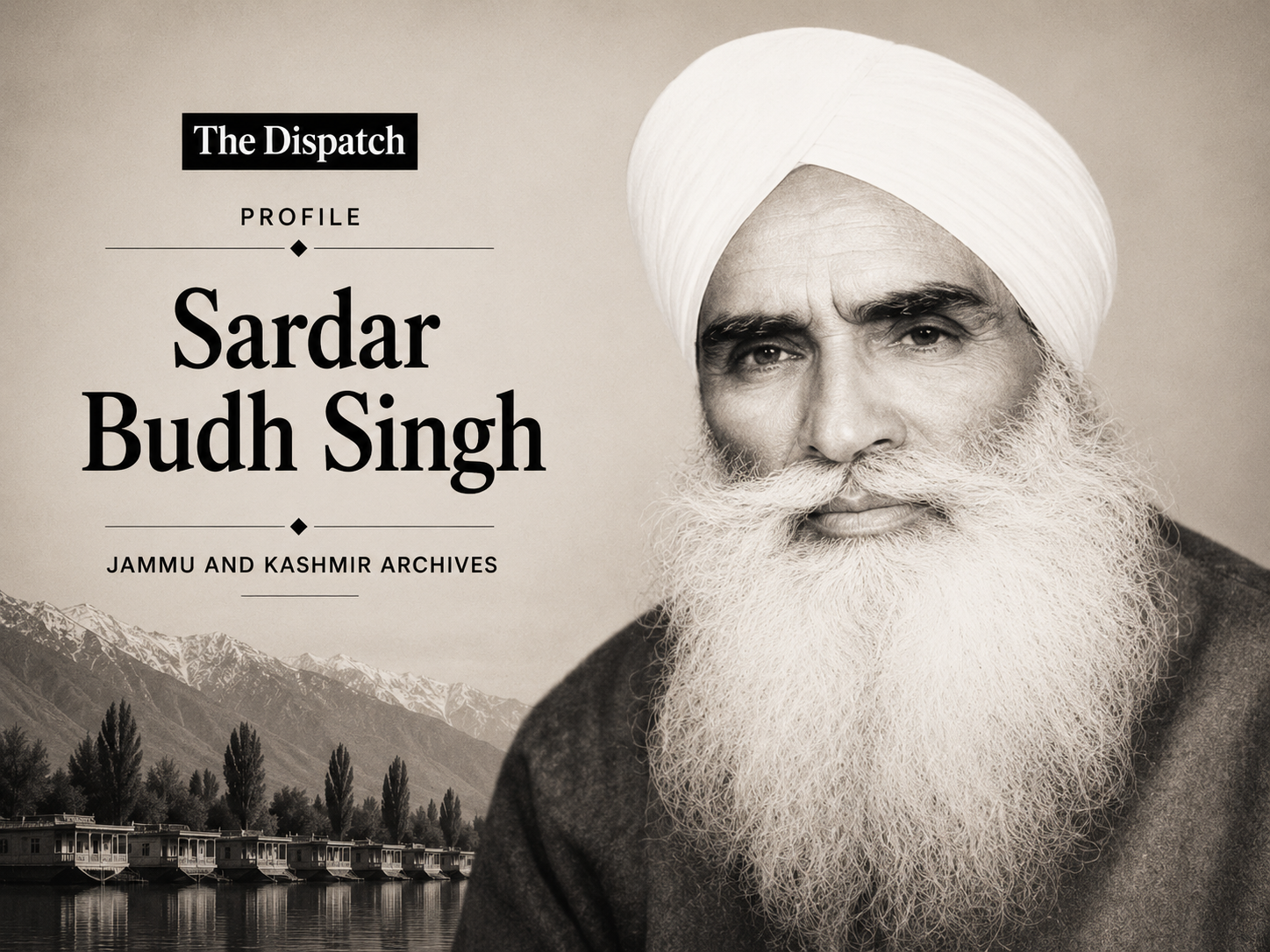
Early Political Activist, National Conference Leader, and Sikh Voice in Jammu and Kashmir
Sardar Budh Singh (16 May 1884 – 16 May 1975) was among the early political figures in Jammu and Kashmir who contributed to the emergence of organised political activity in the state. A Sikh leader of considerable standing, he played an important role in the transition from princely rule to representative politics, while also reflecting the participation of minority communities in the region’s evolving political landscape.
Born in Mirpur (now in Pakistan-administered territory), Budh Singh was educated in Jammu and entered government service in his early years. He rose to a responsible administrative position but resigned from service in the 1920s, choosing instead to engage in public life at a time when political activity in the state was still limited.
In 1934, he founded the Kisan Party, reflecting his interest in agrarian issues and social reform. The same year, he was elected to the Praja Sabha, the legislative body of the princely state, representing the Mirpur–Poonch area. His participation in the Praja Sabha placed him among the early legislators who engaged with questions of governance and representation under the Dogra administration.
Budh Singh later became associated with the National Conference and worked alongside leaders such as Sheikh Mohammad Abdullah during the period of political mobilisation in the 1930s and 1940s. He was elected President of the National Conference in 1942 and again in 1944, reflecting his standing within the organisation during a formative phase.
His political activity extended to the Quit Kashmir movement of 1946, during which he was imprisoned. Like many leaders of that period, he participated in the broader struggle for political rights and constitutional change in the state.
Budh Singh also maintained a presence in Jammu’s civic and social institutions and was associated with bodies such as the Dogra Sabha. His leadership reflected an effort to engage across communities at a time when political identities were still being shaped.
After 1947, he continued to remain active in public life. He served in the administration in the early years after accession, including in portfolios related to public welfare, and later represented the region in Parliament for a period. His role during this phase was part of the wider process of integrating the state’s leadership into national political structures.
Throughout his career, Budh Singh was known for a relatively moderate and measured approach to politics. While he did not dominate the political landscape in the manner of some of his contemporaries, his significance lies in his early participation in legislative politics, his role within the National Conference during its formative years, and his representation of the Sikh community in the state’s political life.
Sardar Budh Singh died in 1975.
His legacy reflects a dimension of Jammu and Kashmir’s political history that is often less emphasised—the contribution of early regional leaders who helped shape institutions, participated in emerging political movements, and ensured that minority communities were part of the evolving democratic framework.
Further Reading
- Budh Singh – Founder of Freedom Movement in J&K (Daily Excelsior)
- Records of the Praja Sabha (1934 onwards)
- Studies on early political mobilisation in Jammu and Kashmir
- Accounts of the Quit Kashmir movement (1946)
Leave a Reply