
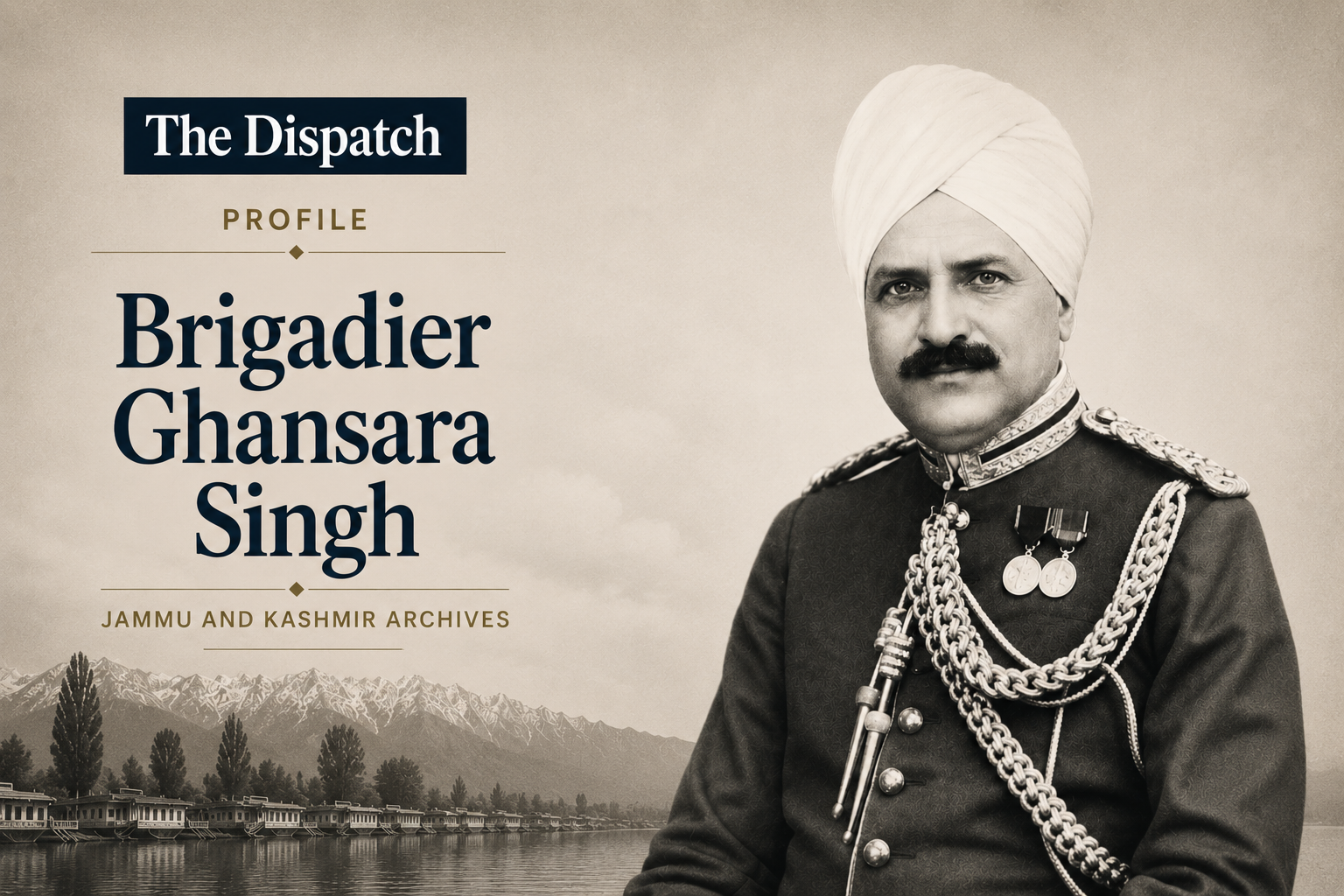
Last Governor of Gilgit, Soldier-Administrator, and Transitional Political Figure
Brigadier Ghansara Singh (1895–1991) was a senior officer of the Jammu and Kashmir State Forces and a significant, though often understated, figure in the turbulent events surrounding 1947. Best known as the last Governor of Gilgit under Maharaja Hari Singh, his career spanned military service, administration, and later political engagement in independent India.
Born in Jammu, Ghansara Singh rose through the ranks of the State Forces and earned a reputation for discipline and administrative capability. By the time of the transfer of power in 1947, he was among the senior-most officers in the princely state’s military establishment.
In August 1947, following the lapse of British paramountcy and the return of the strategically important Gilgit region to the control of the Jammu and Kashmir राज्य, Maharaja Hari Singh appointed him as Governor of Gilgit. Partition of India had already set in motion a complex and volatile situation across the region. Gilgit, bordering multiple strategic frontiers, was particularly sensitive.
His tenure, however, proved short-lived. In early November 1947, local forces under British officers revolted, leading to the collapse of the Maharaja’s authority in Gilgit. Ghansara Singh was arrested during the rebellion, marking a decisive shift in control of the region away from Jammu and Kashmir.
While his role in Gilgit is central to his historical identity, Ghansara Singh’s public life did not end there. In the decades following Independence, he entered electoral politics—an aspect of his career that remains less widely documented.
In the 1967 general elections, he contested and won the Udhampur–Doda Lok Sabha seat, becoming one of the early parliamentary representatives from Jammu and Kashmir after the introduction of direct elections to Parliament. This was the first phase when elected representatives, rather than nominees, were sent from the state to the Lok Sabha.
However, his tenure as Member of Parliament was brief. He resigned from the seat soon after his election, paving the way for Karan Singh to enter the Lok Sabha. Contemporary accounts note that this move was part of a broader political arrangement following Karan Singh’s transition from the post of Governor of Jammu and Kashmir to a role in the Union Cabinet under Indira Gandhi.
This episode illustrates a characteristic feature of the political system of the time—where electoral outcomes and positions were sometimes shaped by larger political considerations and alignments between the Centre and regional leadership.
Ghansara Singh’s career thus reflects multiple transitions: from a state forces officer, to a frontline administrator during the 1947 crisis, and later to a participant in parliamentary politics. Unlike mass political leaders, his influence operated within the domains of administration, strategy, and institutional continuity.
Brigadier Ghansara Singh passed away in 1991.
His legacy lies in his association with a critical moment in Jammu and Kashmir’s history—the loss of Gilgit—and in his later, quieter role within India’s evolving democratic framework. He represents a category of leadership that bridged the princely state structure and the post-Independence political order, navigating both with a degree of adaptability shaped by circumstance.
Further Reading
- Studies on the Gilgit revolt of 1947 and its strategic implications
- Last Governor of Gilgit (Daily Excelsior)
- Parliamentary records of the 1967 general elections in Jammu and Kashmir
Leave a Reply